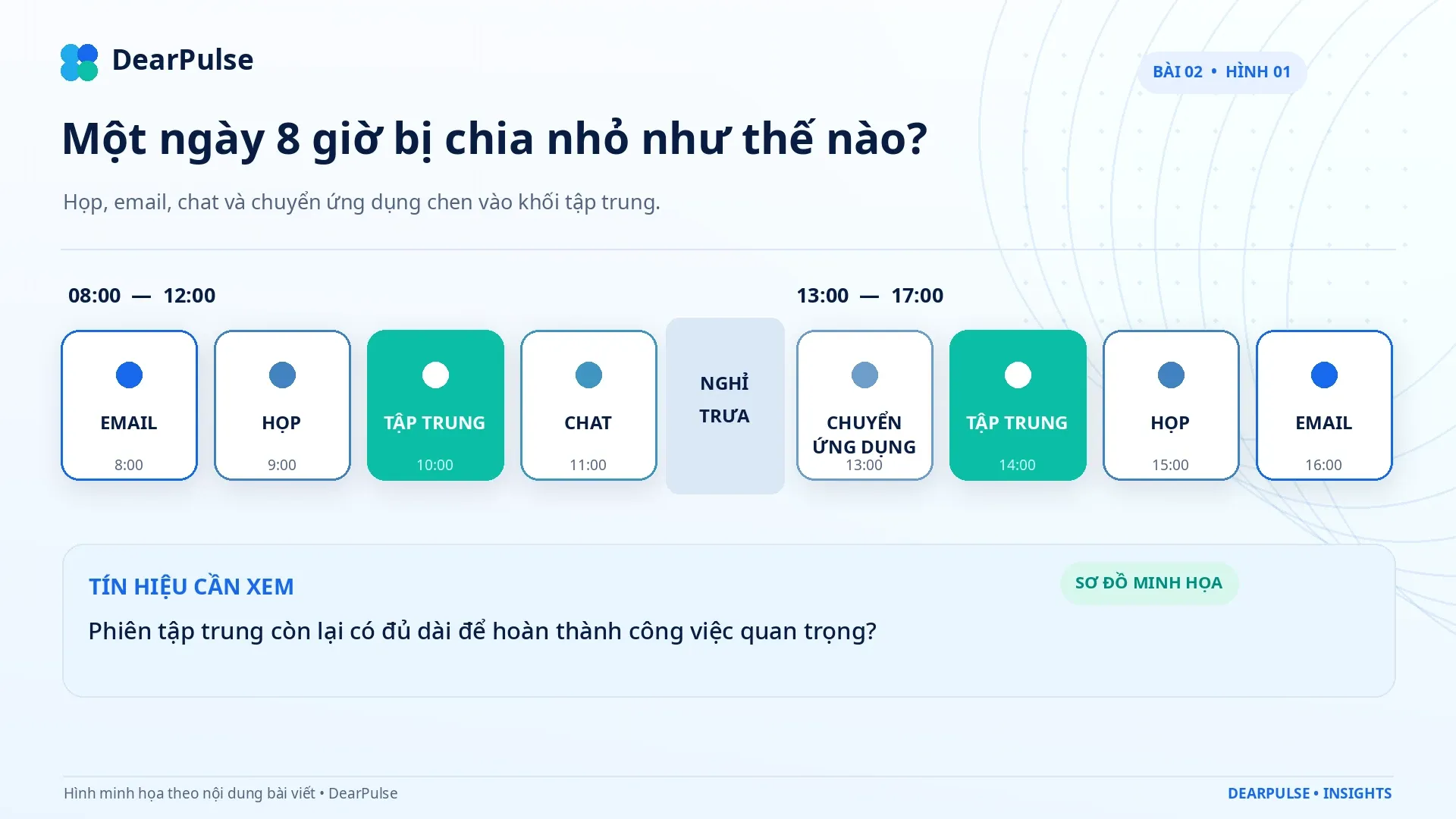
A notification takes only a few seconds to read, but the problem is not those few seconds. The cost appears when an employee has to leave the task at hand, switch into a different context and then rebuild their earlier train of thought. If that repeats many times over, a full eight-hour day still lacks the unbroken stretches needed to finish difficult work.
Microsoft found that the 20% of Microsoft 365 users receiving the most signals get around 275 emails, meetings or messages in 24 hours. That figure does not represent every employee; its significance is in showing that, among groups with a high volume of communication, the communication infrastructure itself can become a source of fragmentation. ActivTrak separately recorded a 34% rise in collaboration time and a 12% rise in multitasking across its 2023–2025 dataset. Two different measurement sources, but both lead to the same question: are businesses collaborating more, or are they forcing employees to switch context more?
Which three layers hold the cost?
Layer 1 – Direct cost: the actual time taken by the meeting, the message or the ad-hoc request.
Layer 2 – Switching cost: the time spent re-reading documents, recalling earlier decisions and re-establishing focus.
Layer 3 – Knock-on cost: deadlines stretching out, more errors, work that has to be redone or gets pushed into after-hours.
So the point of interruption data is not that "messages are bad". It helps a business find where the knock-on cost has grown larger than the value of the coordination.
The causes worth checking
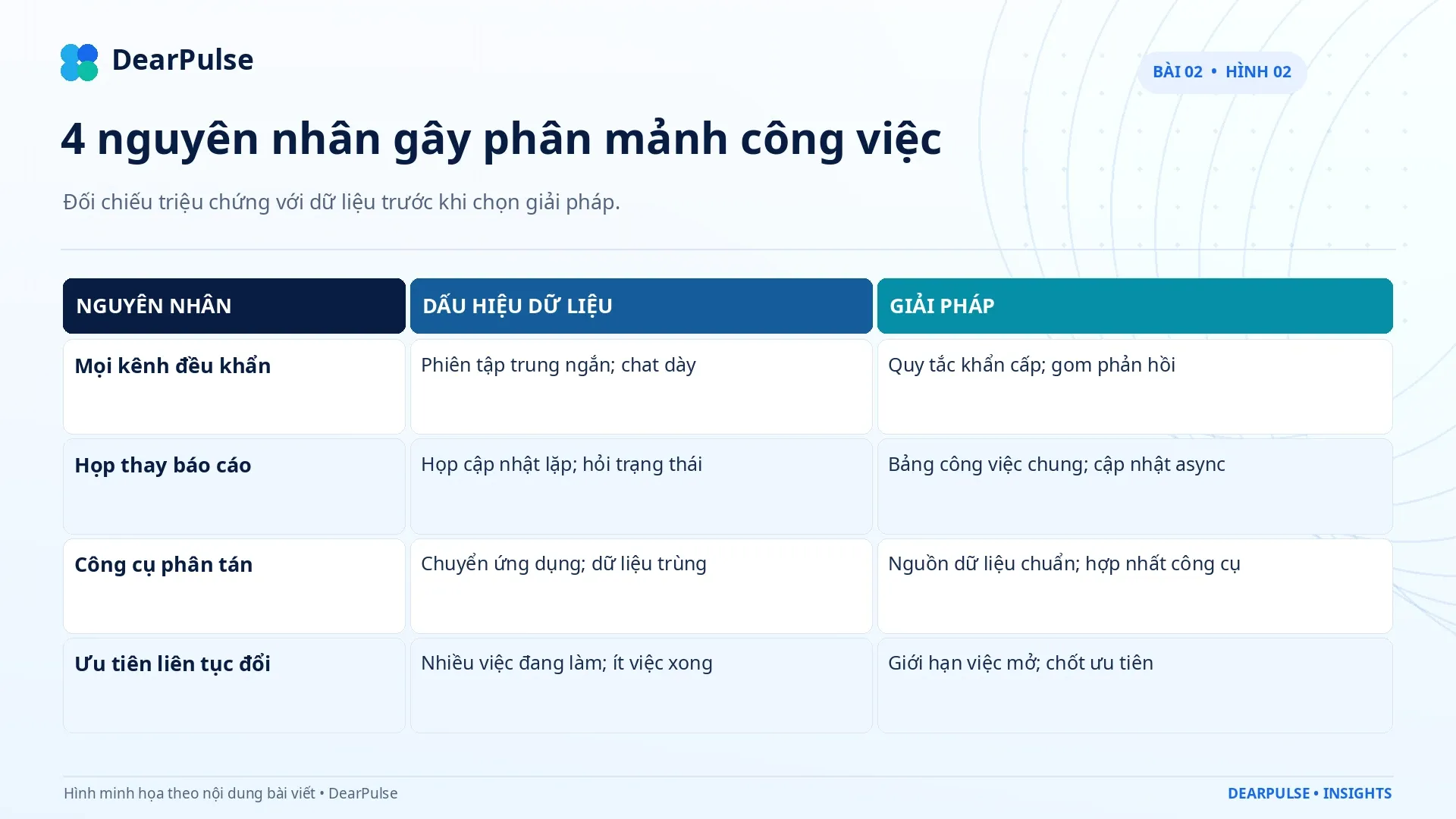
Cause 1: Every channel is treated as urgent
When email, direct chat, group chat and phone calls all demand an immediate reply, employees cannot tell what is genuinely urgent from what can wait.
Warning signs: a large number of very short working sessions; high chat volume during periods that require focus; employees routinely finishing important work at the end of the day.
Solution: designate one channel for urgent matters; set an expected response time for each channel; batch non-urgent questions into fixed windows; allow notifications to be switched off during focus blocks.
Cause 2: Meetings and status updates substitute for an information system
If the status of a piece of work exists only in the head of the person doing it, managers have to keep asking and keep holding meetings to know where things stand.
Warning signs: repeated status meetings whose minutes contain no decisions; the same information reported through several channels; managers spending a lot of time asking "where are we on this?".
Solution: standardise work status, owner and due date in one shared system; move status updates to asynchronous reporting; keep meetings only for making decisions or unblocking problems.
Cause 3: Too many tools and scattered data
Employees have to open several applications to find documents, cross-check information or re-enter the same data.
Warning signs: constant app switching; duplicated information; errors caused by working from different versions of a document; high processing time but low time spent producing output.
Solution: define the source system for each type of data; consolidate tools with overlapping functions; use consistent templates and handover procedures; integrate only after the data flow has been clarified.
Cause 4: Priorities change but old work is never stopped
A new request gets added, but nobody decides which task has to move back. Total load rises and the important work gets chopped into fragments.
Warning signs: many items "in progress" but few completed; deadlines constantly shifting; employees working after hours even though the total number of tasks has not risen sharply.
Solution: cap the number of items in progress; require every urgent request to come with a decision about what gets deferred; have team leads review priorities weekly.
How should the cost be estimated?
A reference formula: Number of employees × minutes that could be recovered per day × working days × labour cost per minute.
As a hypothetical example, 50 people each cut 20 minutes of unnecessary interruption per day, over 22 days a month, at a labour cost of VND 100,000 per hour. The time opportunity is equivalent to roughly 366.7 hours and VND 36.7 million per month. This is only the monetary conversion of time, not an audited loss or a guaranteed saving.
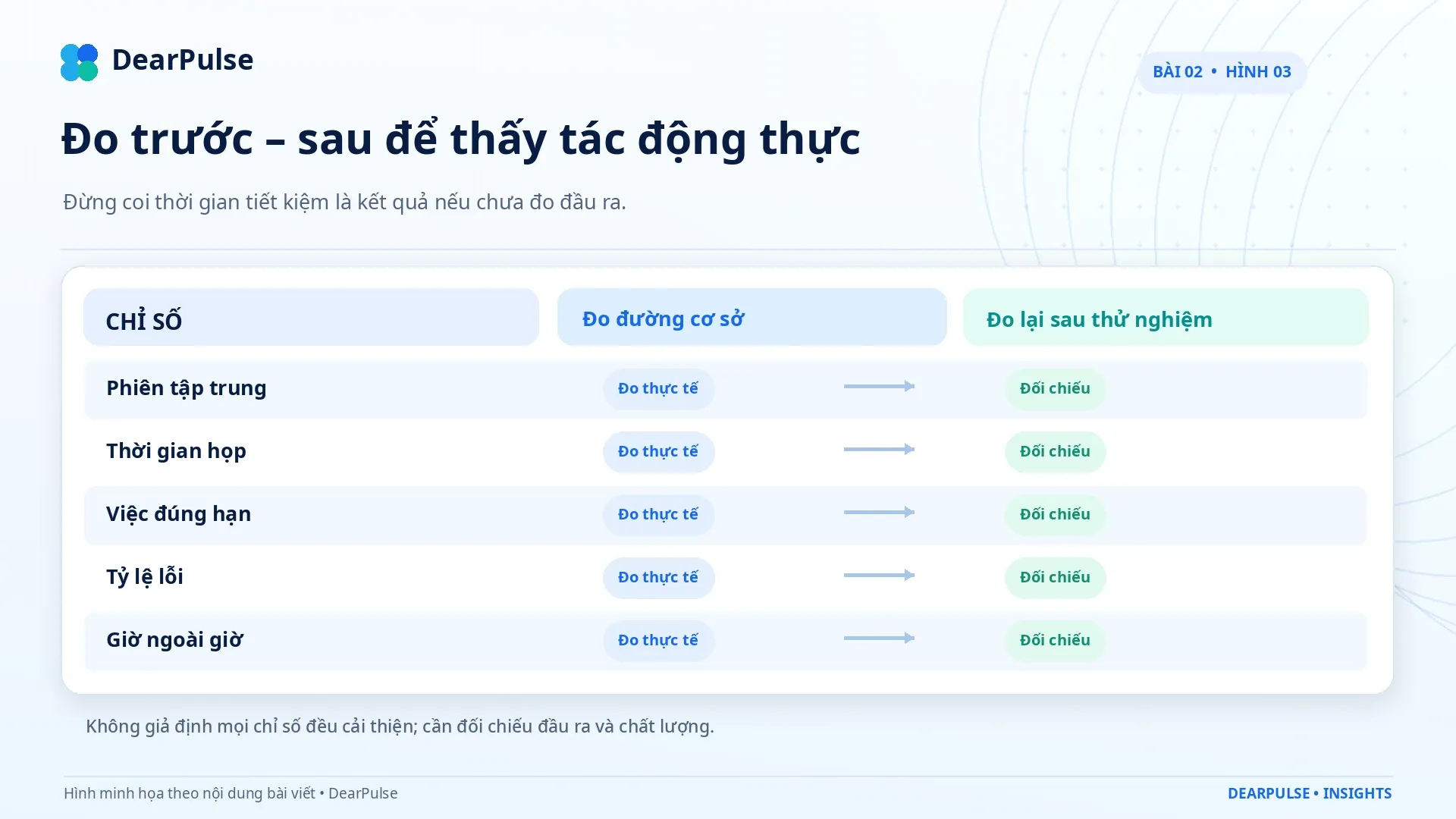
To prove the value, a business must also measure items completed, cycle time, error rate and overtime. If focus time rises but output does not change, the cause may lie in skills or in some other process.
A 30-day plan
Week 1: measure the baseline. Week 2: classify interruptions into valuable and unnecessary. Week 3: trial one solution that matches the actual cause. Week 4: compare output, quality, progress and overtime. Do not cut meetings, switch off chat and change tools all at once, or you will never know which change produced the effect.
How does DearPulse help?
DearPulse makes the relationship between applications, focus rhythm and completed work visible. The system does not just answer "how often are employees interrupted?" — it helps identify whether the interruptions come from communication channels, the meeting calendar, the tools or the way work is prioritised. From there, a business can choose the right solution and measure again.
CTA: Pick one department, identify one primary cause and run a 30-day trial.