The workday is getting shorter, yet productive activity time is going up. Employees are using AI more, communicating more and handling more tasks. It sounds like the ideal productivity picture. But new data reveals the other side of it: the ability to sustain uninterrupted stretches of work is in decline.
In its State of the Workplace 2026 report, the ActivTrak Productivity Lab analysed more than 443 million hours of digital work activity from 163,638 workers across 1,111 organisations, collected over the 2023–2025 period. Under the platform's classification, productive working hours rose 5% to an average of 6 hours 36 minutes a day, even though the length of the workday fell by around 2%. Over the same period, collaboration activity rose 34%, multitasking rose 12%, and the share of time spent focused fell from 63% to 60% [1].
The concerning issue is not that employees are becoming less willing to concentrate. It is that the way work is organised may be driving more activity while making unbroken stretches of thinking rarer.
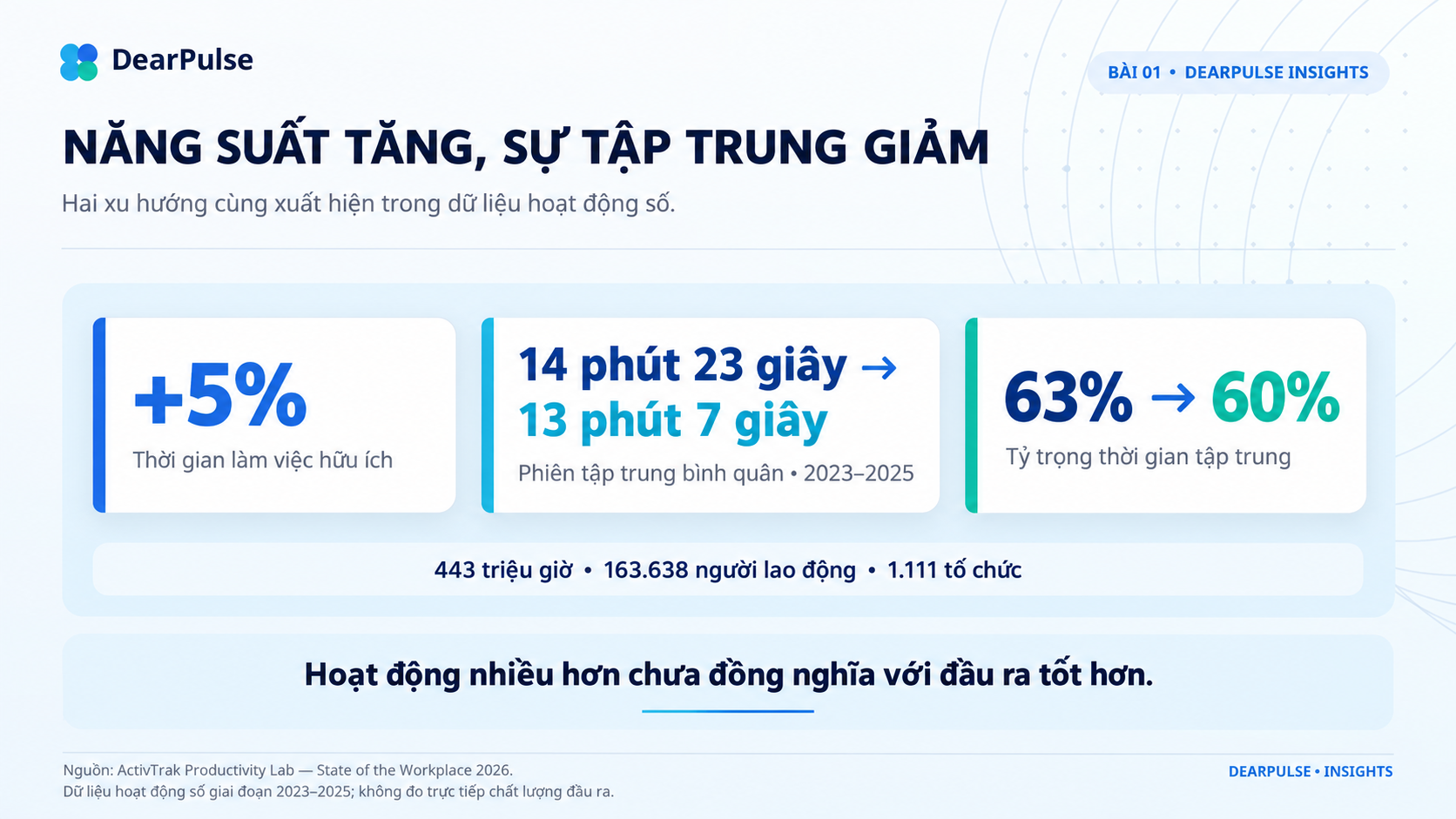
Trends in productive and focused time according to ActivTrak's 2026 research.
1. What paradox does 443 million hours of data reveal?
The first thing worth noting is that ActivTrak's "productive time" is determined from time spent in applications and on websites classified as work-related. It is not a direct measure of output volume or output quality. An employee working for hours in specialist software may be handling important work, but may equally be fixing errors or re-entering data.
According to the report, the average focus session fell from 14 minutes 23 seconds in 2023 to 13 minutes 7 seconds in 2025, a drop of around 9%. "Focus efficiency" — the share of digital activity time regarded as focused — fell from 63% to 60%. Meanwhile, collaboration time rose to 52 minutes a day and multitasking time reached roughly 1 hour 33 minutes a day [1].
These numbers do not mean employees can only concentrate for 13 minutes. They describe the average length of an uninterrupted activity session as the study defines it. Focus away from the screen, task difficulty and product quality are not fully reflected by this metric alone.
Limits aside, the trend is still worth a manager's attention. If employees have to rotate between meetings, chat, email and specialist tasks, the time available for each train of thought may get chopped up. The potential consequences are re-reading documents, rebuilding context, reshuffling priorities or pushing difficult work to the end of the day. These are hypotheses to be tested at each individual business, not causal consequences proven by ActivTrak's aggregate figures.
2. Which companies have tried to optimise focus, and how?
One of the cases with the most direct data comes from ActivTrak itself, the company that builds the work activity analytics platform. In 2021, operating under a remote-first model, the company trialled a Focus Fridays policy: reducing internal meetings on Fridays so employees had time for independent work [2].
But instead of assuming the new policy worked, ActivTrak measured the actual activity. The company realised that a fixed "no-meeting" day does not necessarily suit every team's needs. Mid-year, it moved to focus blocks of around four hours that teams arranged for themselves, combined with Slack "away" status and "Focus Time" calendar holds so colleagues would respect those periods.
A separate exploratory analysis by ActivTrak found that teams holding daily focus blocks gained an average of one extra hour of productive working time per day, while teams that chose a single whole focus day gained only about 0.4 hours [3]. This is a comparison of internal practice, not a randomised experiment capable of attributing the whole difference to focus scheduling.
ActivTrak's results after the change
In its 2021 wrap-up, ActivTrak published two results: focus session duration rose from 11.2 to 14.1 minutes; and time lost to context switching and distraction fell from an average of 56 to 40 minutes per person per day [2].
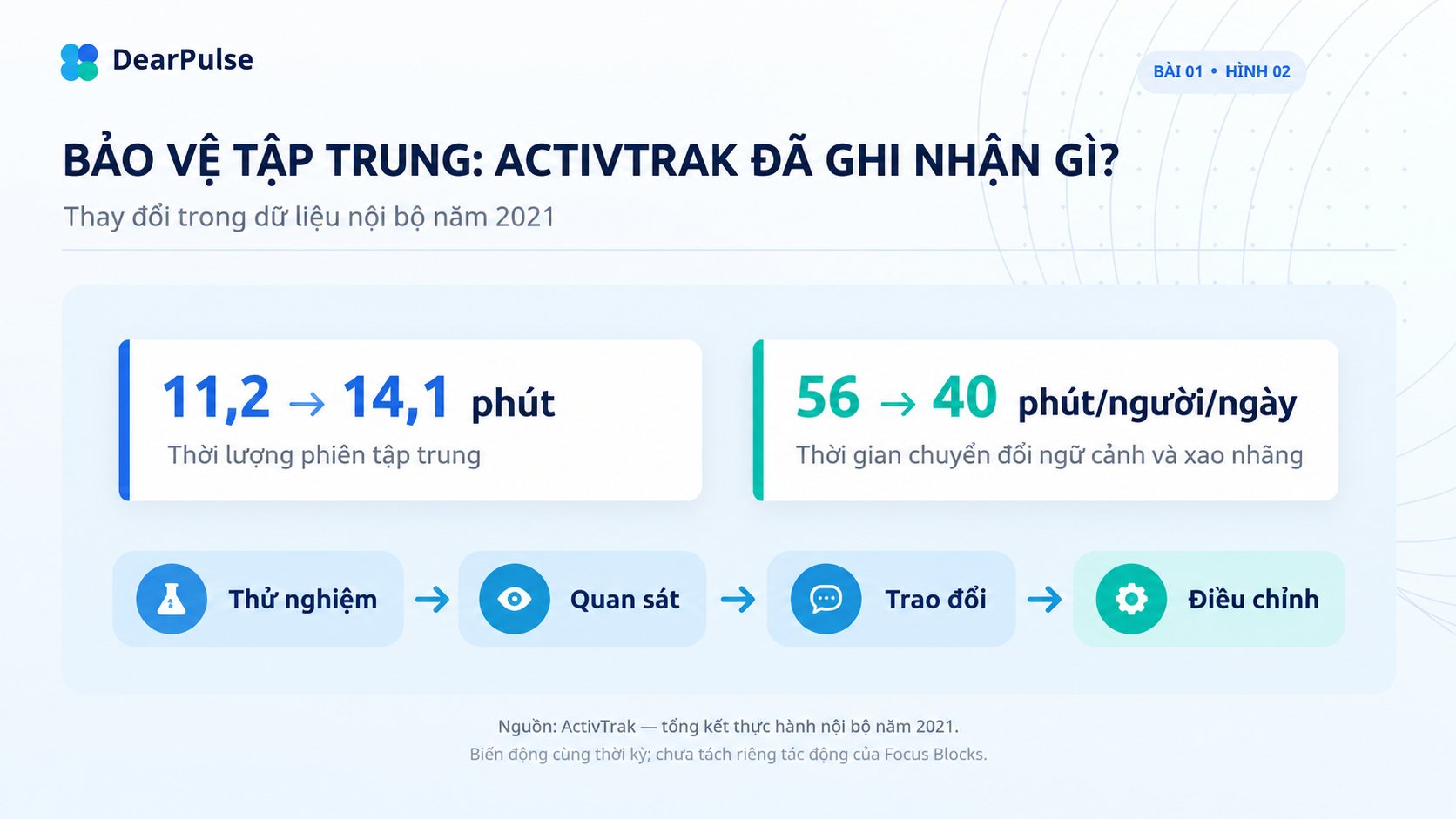
Changes in ActivTrak's internal practice data in 2021.
It is important to be precise about what these results are: evidence of a change in working rhythm that the company recorded within the same year. The source does not provide a reliable measure of how much revenue or product quality rose thanks to focus blocks alone. Both metrics may also have been influenced by other operational changes made during that year.
The lesson worth learning is the management loop the company applied: trial a working rule → observe the data → ask employees for their views → adjust the rule → keep monitoring. Banning meetings does not automatically raise productivity; the challenge is finding a way to protect the time that needs focus while still maintaining effective coordination.
3. Why should managers not simply demand that people "focus more"?
ActivTrak's 2026 figures show collaboration time up 34% and multitasking up 12% over the 2023–2025 period, while the share of focused time fell to 60% [1]. Movements over the same period do not in themselves prove causation. But they do show that you have to look at how work is organised rather than merely asking employees to concentrate harder.
There are at least three causes to separate out when focus data is low.
Interruption from communication: messages, notifications or meetings cutting into tasks that require depth. The solution is to classify levels of urgency, batch non-urgent exchanges and set windows where interruption is restricted.
Interruption from priorities: employees open too many pieces of work at once because new tasks keep being added while old ones are never deferred. The solution is to set clear priorities and cap the number of items in progress simultaneously.
Interruption from process: employees have to leave a task to hunt for a file, wait for approval, chase a status or perform a manual step. In this case, switching off notifications is not enough; the workflow itself needs improving.
For that reason, increasing focus time should not become an identical mandatory KPI for every department. Sales, customer care and coordination roles need continuous collaboration; marketing, engineering and analytics may need longer stretches of deep work. The best approach is to measure by role group and cross-check against output quality.
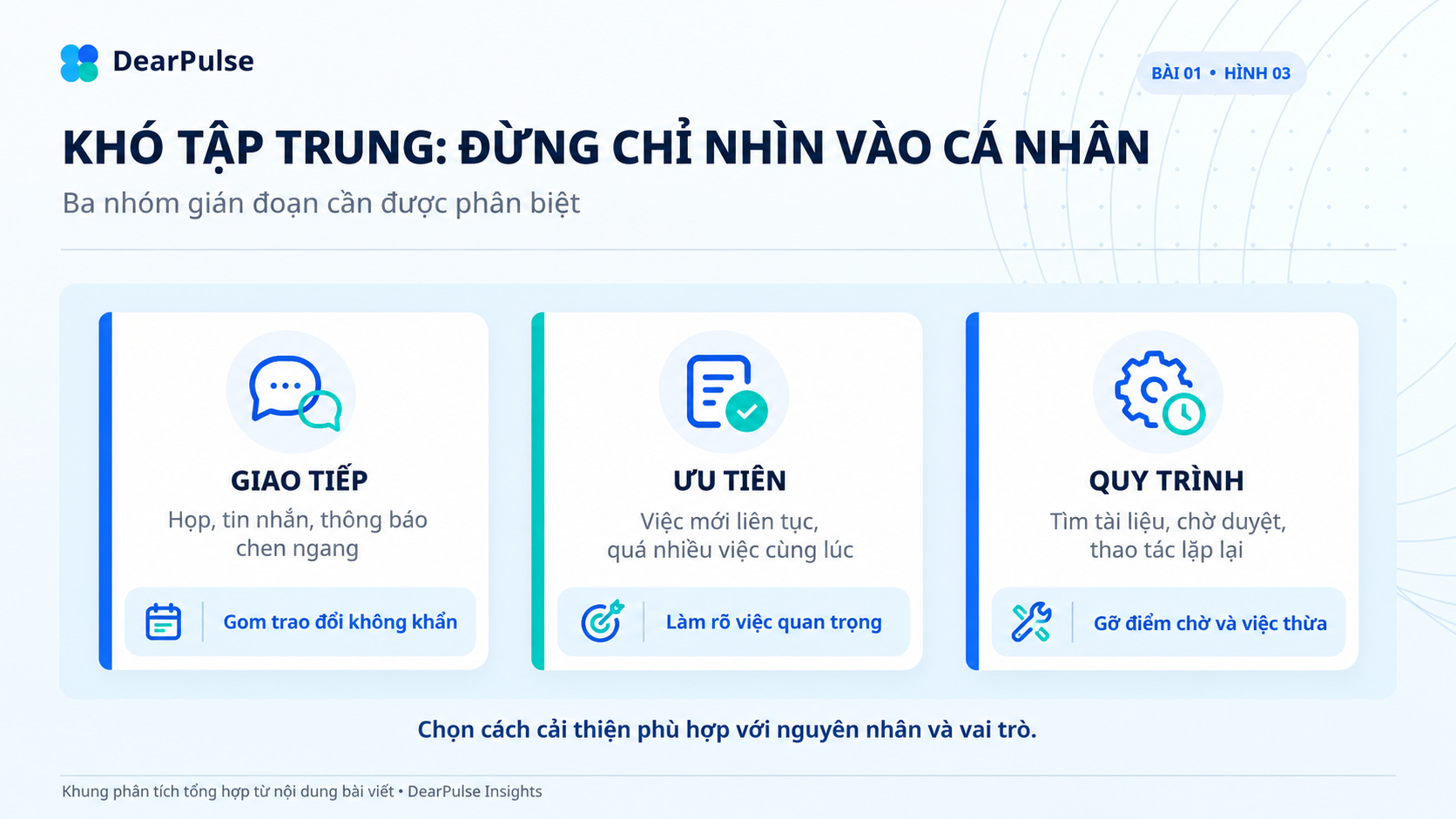
Three groups of interruption that must be distinguished before choosing how to improve.
4. Applying these lessons in Vietnamese businesses with DearPulse
What can be learned from ActivTrak is that you have to see the problem before applying a solution, then reassess with data. With DearPulse, a business can approach the problem through the two layers already presented on the product website: activity and time data, and work and progress data [4].
At the activity layer, information on application usage time, working time and time allocation trends can suggest which periods of the day tend to get fragmented. Application classification needs to suit the specifics of each role, avoiding the default assumption that chat or meetings are always unproductive activity.
At the work layer, managers track which tasks are running late, who is responsible, how progress is going and whether results have been completed and approved. This is the essential cross-check layer: if focus time rises but work is still slow, you have to keep examining requirements, process and output quality.
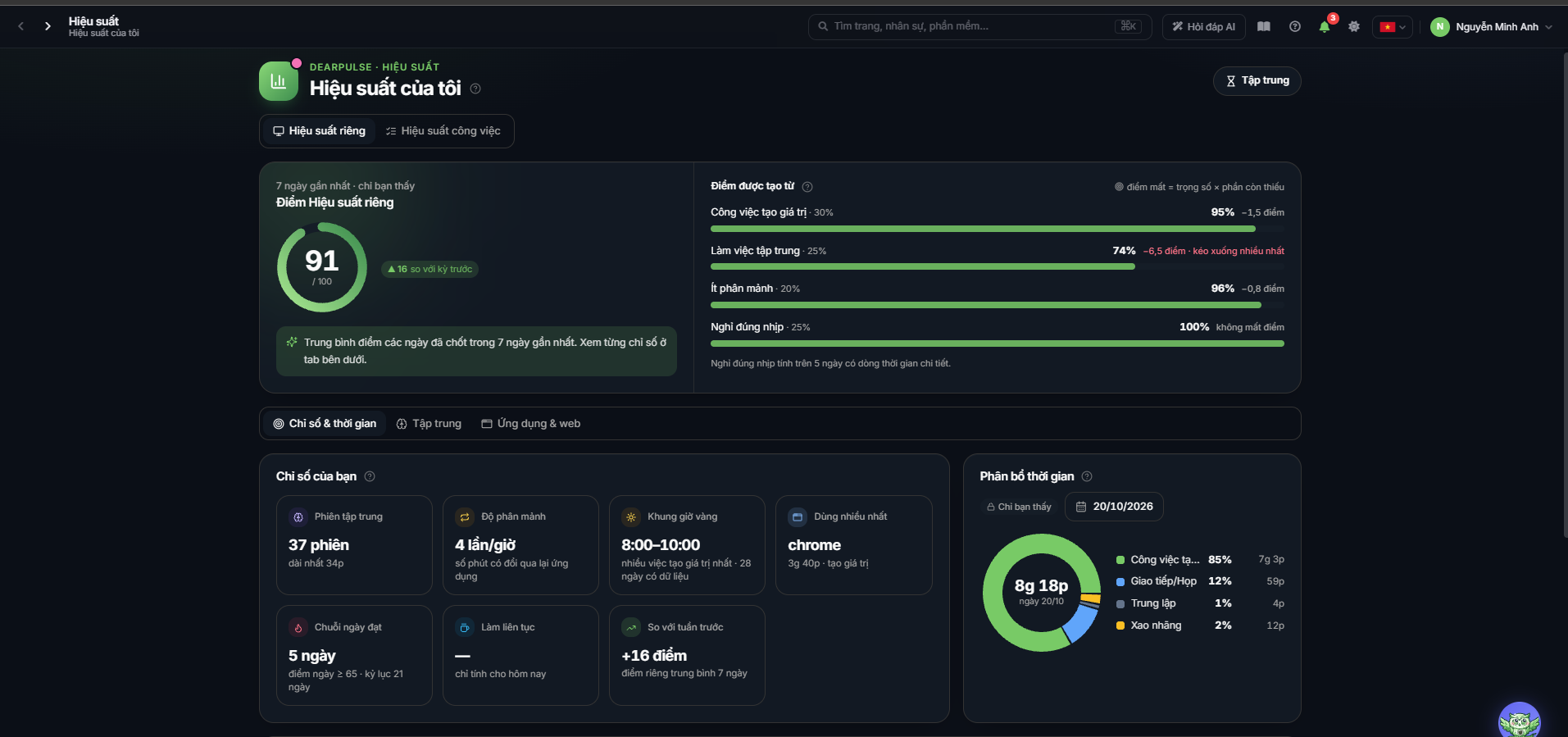
DearPulse helps individuals review their performance score, focus rhythm and time allocation.
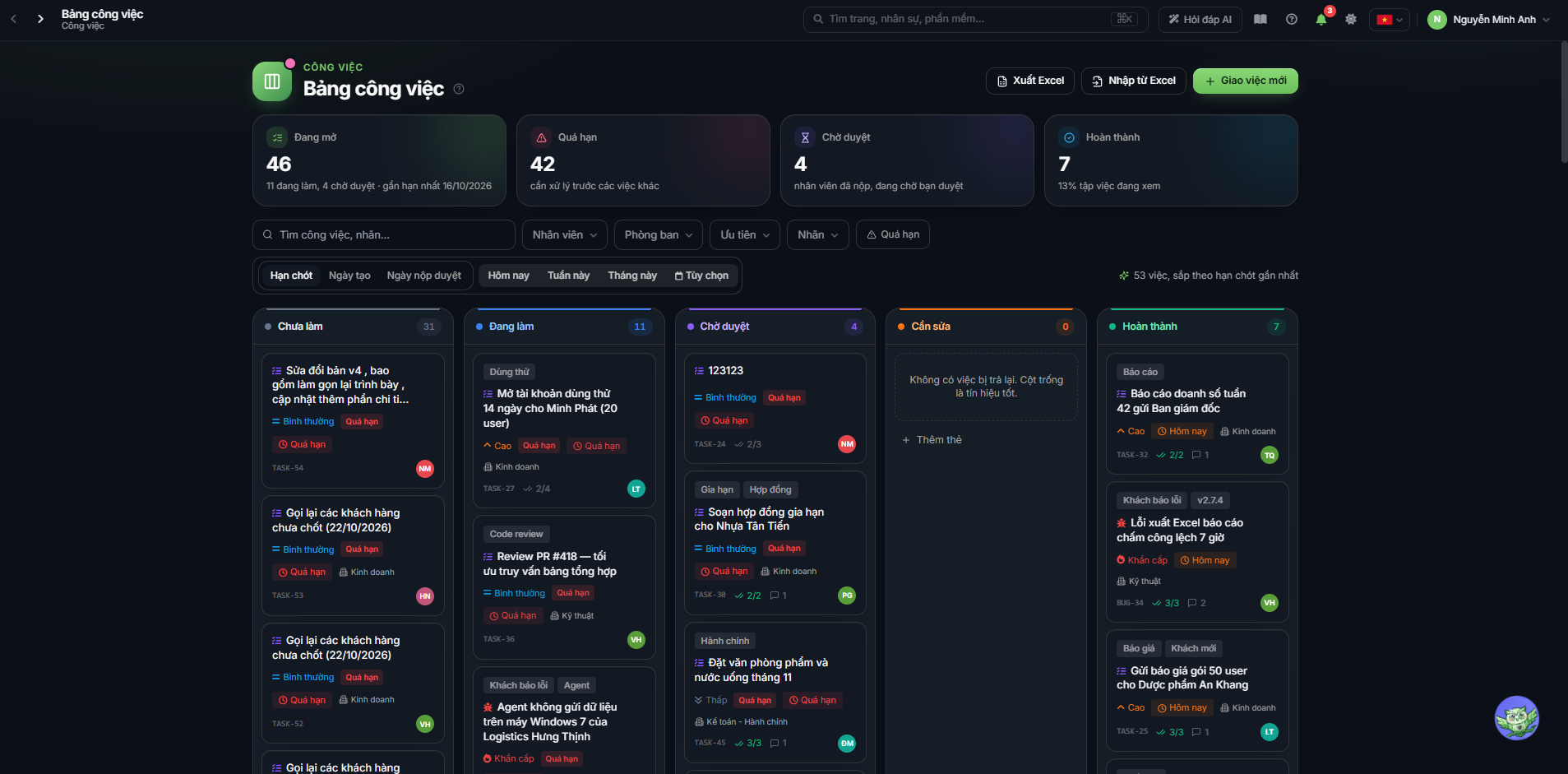
Comparing time data against work status and results in DearPulse.
When rolling this out, a business needs to confirm which feature set is available in the version it is using and agree on how the data should be read for each role. Improvement needs to be assessed through both working rhythm and task results.
5. How far do the available findings let us go?
According to State of the Workplace 2026, the average workday length in the sample fell from 8 hours 53 minutes in 2023 to 8 hours 44 minutes in 2025, while time spent in applications classified as work-related rose to 6 hours 36 minutes a day. That increase is not direct data about business output [1].
In ActivTrak's 2021 internal study, focus session duration rose from 11.2 minutes to 14.1 minutes, while time lost to context switching and distraction fell from 56 to 40 minutes per person per day [2]. A separate analysis found that teams adopting daily focus blocks gained an average of 1 hour of productive working time a day, compared with a 0.4-hour gain for teams that set aside a whole day for focus [3].
These results reflect the digital activity metrics and working habits that ActivTrak was able to measure. Neither source publishes a controlled comparison showing how much the change in focus time alone raised revenue, output or work quality. The evidence-based lesson, therefore, is that you need to assess working rhythm with data and then check output as well before claiming a business benefit.
When evaluating the effectiveness of using DearPulse, a business needs to connect time reports with the tasks, progress and results recorded in the system. The actual level of improvement needs to be verified in the context of your own deployment, rather than assumed from another company's results.
Conclusion: focus time is a resource that has to be designed, not just demanded
ActivTrak's data shows that productive activity time can rise while focus session duration falls. ActivTrak's own internal experience shows that policies protecting working time need to be flexible by team and adjusted using real data.
The lesson for Vietnamese businesses is not that "every employee must achieve three hours of deep work a day". The lesson is to identify where time is being fragmented, protect the focus stretches that are genuinely needed, and demonstrate improvement through work results. DearPulse can play a supporting role in comparing working-rhythm data against task management; the optimisation decisions still require the involvement of both employees and managers.
Pick one department and measure working rhythm, progress and work quality together over 30 days, before adding more KPIs or asking employees to work longer hours.
Sources and limitations
-
[1] ActivTrak Productivity Lab, State of the Workplace 2026, 2023–2025 data
-
[3] ActivTrak, Why Workplace Analytics Are Critical No Matter Where People Work
Scope of interpretation: the research uses data from users of the ActivTrak platform and is not statistically representative of the Vietnamese workforce as a whole. Digital activity metrics do not directly measure work quality; ActivTrak customer figures are not results obtained from using DearPulse.