In any department, everyone can be busy. Employees are constantly processing files, answering messages, updating statuses and attending meetings. Yet when the deadline arrives, many tasks are still unfinished. The question usually asked is “Who is slowing things down?” A more useful question may be: At which step is the work waiting, and does the way we coordinate need to change?
Two cases published in Vietnam help distinguish individual performance from team performance: FPT IS and the Vietnam Scientists Heritage Center (MEDDOM). One manages the flow of internal requests in an organization of thousands of people; the other must coordinate thousands of tasks a month across many different work groups.
1. FPT IS: More than 120,000 work items resolved, with an on-time rate of up to 85%
According to materials introducing FPT SPro, published in VnExpress’s Digital Operations section in 2020, FPT IS has used this solution since January 2018 across more than 3,000 employees. The system has helped resolve more than 120,000 work items, with an on-time completion rate of up to 85%; the time needed for payment processing was shortened by up to seven days compared with the traditional method [1].
These figures are noteworthy, but they need to be read correctly. 85% is the published on-time rate, not an 85% productivity gain. More than 120,000 is the cumulative volume of work items resolved up to the time of publication, not 120,000 tasks a month. The reduction of up to seven days applies only to payment operations within the scope stated in the source.
What did FPT IS change?
For administrative and payment requests, work typically passes through several roles: the requester, the processing unit, the review unit and the approval level. Before digitization, information could sit on paper or across multiple communication channels. A manager who wanted to know the status had to ask each contact point; one file with missing information could stall the whole process.
FPT IS uses FPT SPro, a platform for digitizing processes and assigning work automatically. The tool lets requests be received through a single channel, files be updated online, relevant people be notified, approvals be given remotely and progress be tracked step by step [1][2].
What improved was not just the speed at which one employee works. More importantly, the workflow gained a clear status, a clear owner and the ability to be looked up. As a result, a business can cut the time lost to asking about progress, hunting for paperwork and waiting for information to be passed along manually.
Management lessons from FPT IS
FPT IS data shows that payment processing time fell by up to seven days compared with the traditional method [1]. FPT describes changes in request intake, file routing and online approval. The source does not break down the reduction by stage, so it is not possible to quantify exactly how many days came from direct handling versus waiting time; the only conclusion is that the payment process was reported as completing faster.
FPT IS is a real-world case that shows the value of transparency and process orchestration. No public source measures employees’ Deep Work time separately, so the seven-day reduction cannot be concluded to be a direct result of employees being more focused.
2. MEDDOM: When 4,000–5,000 tasks a month cannot be managed with meeting notes
MEDDOM carries out research, preserves scientific heritage, organizes visits and runs related projects. According to the organization’s leaders in a MISA case study, the monthly volume can reach 4,000–5,000 tasks [3].
A multi-field organization like this must manage many different work groups, from research and events to business and construction. The initial method was to assign tasks at the weekly briefing meeting and record them on paper, then compile the information to evaluate KPIs. The problem was not whether each employee did more or less, but the management cost and the ability to track the exact progress of thousands of tasks.
What tool does MEDDOM use?
MEDDOM chose MISA’s AMIS Công việc (AMIS Tasks) to centralize task assignment, track progress and deadlines, and use completion data in work evaluation. The organization’s leaders say managers can see how many tasks staff completed last month and how far they fell behind plan. The system also supports communication on the platform instead of across scattered channels [3].
According to the case study, the number of deployed users grew from about 45 to nearly 90. This is the number of people using the software, not a result of new hires, and not evidence that productivity doubled. The source does not publish a productivity gain measured directly before and after using a consistent formula.
What is worth learning from MEDDOM
This case shows that a task management tool is valuable when it turns a large task list into information that can be used for decisions: which tasks are done, which are overdue, who is responsible and which teams face the most obstacles.
What any business should analyze next is this: after work assignment becomes more transparent, does the on-time rate rise; does time spent in status-update meetings fall; is there less work to be re-asked or redone? These are follow-up research questions, not quantified results that MEDDOM has published.
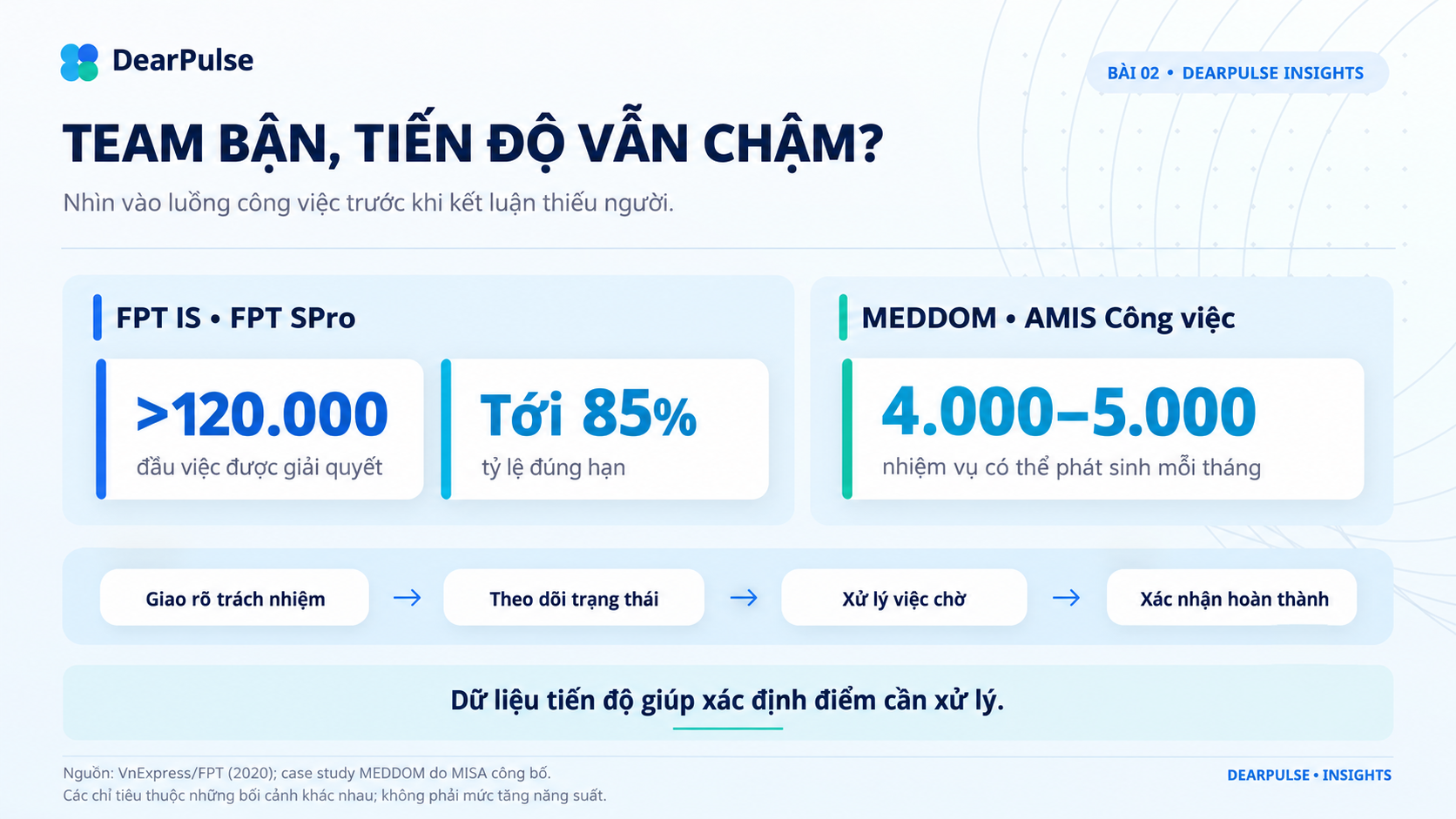
Figures published by FPT IS and MEDDOM, each in its own deployment context.
3. Why do many people work nonstop, yet the team still misses deadlines?
The two cases above reflect a common problem: how busy each individual is does not equate to the speed at which work moves through the whole team. This phenomenon can be analyzed through four bottlenecks.
Handoff bottleneck: work is finished at step A but waits for someone at step B to pick it up. If responsibility and handoff timing are unclear, waiting time keeps growing.
Approval bottleneck: one person or one management level has to approve too many proposals; the queue grows long even when employees process their work well.
Priority bottleneck: team leads keep adding urgent work without stopping old work. The team works on many things at once, but the completion rate is low.
Information bottleneck: requests, files and feedback live in multiple channels, forcing employees to ask again or revise a single task over several rounds.
To diagnose correctly, you can’t just count open tasks. You need to measure the time from start to finish, the number of step transitions, the number of rework requests and which stage most often drags on.
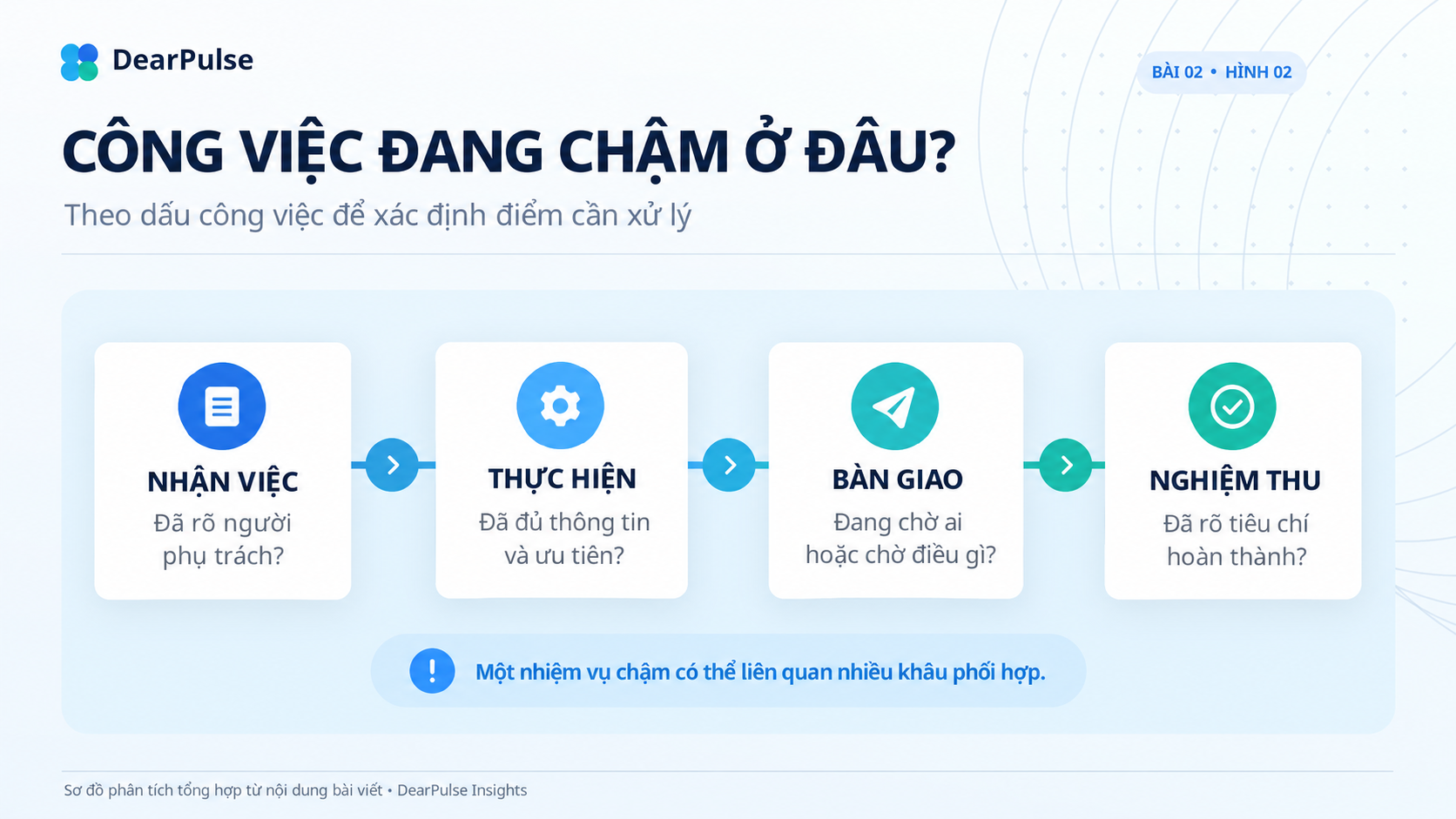
Tracing work through intake, execution, handoff and acceptance.
4. What evidence shows the bottleneck lies in the process?
At FPT IS, the FPT SPro system was deployed in January 2018 for an organization of more than 3,000 employees. As of the article published on July 15, 2020, more than 120,000 work items had been resolved; the on-time rate reached up to 85% and payment processing time fell by up to seven days compared with the old way [1].
The article explains how FPT SPro works: requests are created in one system, files are updated online, multiple levels can approve remotely and departments can track processing status [1]. This is evidence of process change accompanied by published results, but there is no detailed data to split the seven-day reduction into direct handling time and waiting time.
At MEDDOM, MISA reports that the volume can reach 4,000–5,000 tasks a month. Moving from meeting notes to AMIS Công việc helped the organization track status and assess the number of completed and delayed tasks; the number of user accounts rose from 45 to nearly 90 [3]. However, the case study does not publish before-and-after on-time rates or the number of meeting hours saved, so no improvement figures can be given for these metrics.
Based on these two public sources, the appropriate conclusion is that systematizing the process adds the ability to track, coordinate and check results; no unpublished productivity gain should be attributed to FPT IS or MEDDOM.
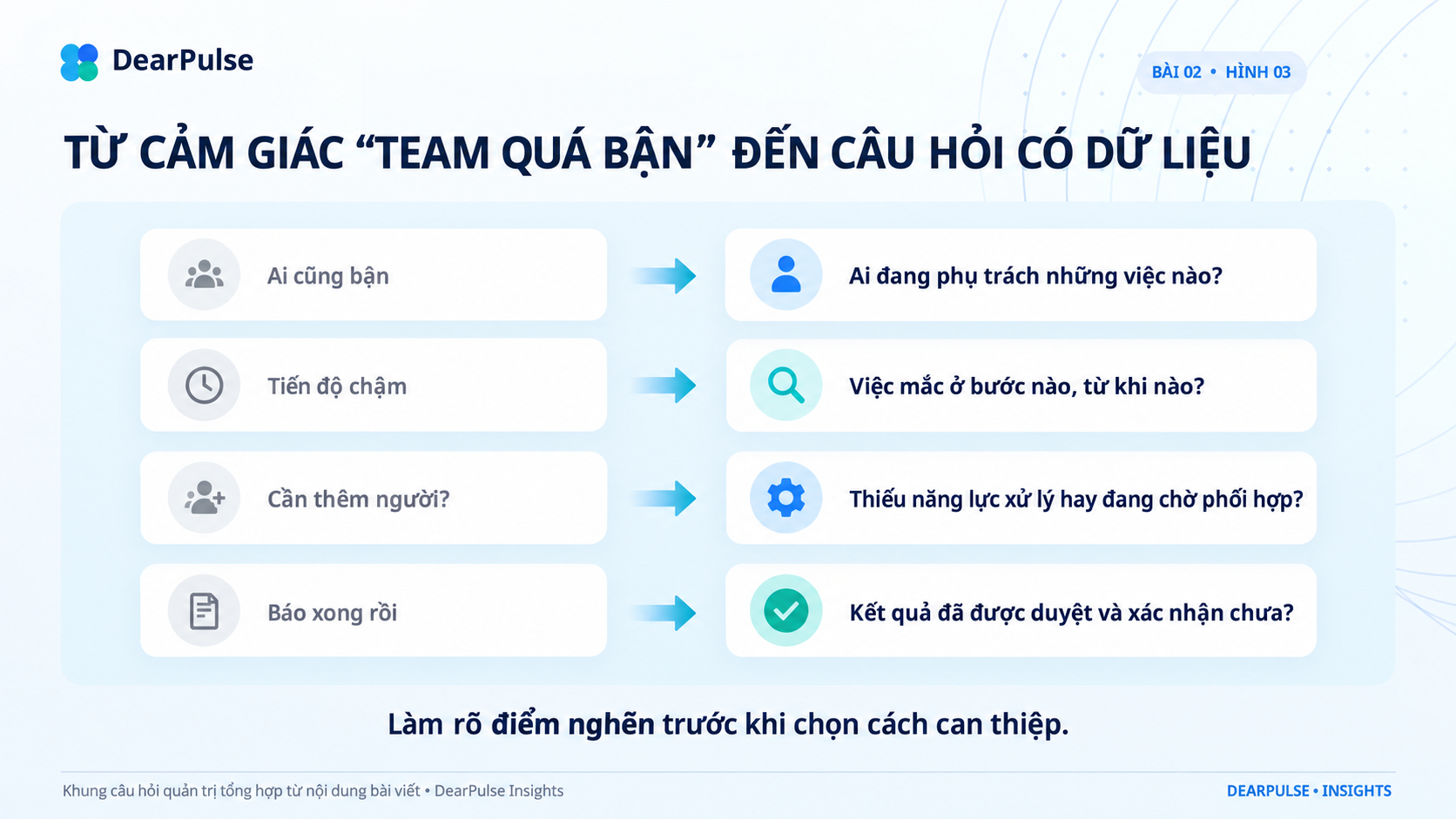
Turning the feeling of a team being too busy into data-backed questions.
5. How does DearPulse help managers approach this question?
Both Vietnamese cases point to a basic need: work assignment must be clear, status must be recorded, and managers need to see progress without constantly asking employees. This is the class of problems addressed by the task, workflow and performance reporting features that DearPulse promotes [4].
At the employee level, doers need to know which tasks are the priority, which deadlines are coming up and what standard the deliverable must meet. Showing work in one place helps prevent requests from being forgotten among many messages.
At the team-lead level, managers need to see the list of work in progress, overdue, awaiting response, completed and awaiting approval; from there they can identify where support is needed instead of reminding all staff in the same way.
At the department level, aggregated progress and performance data show which groups of work are often late, whether workload is piling up on a few contact points and how results change between periods.
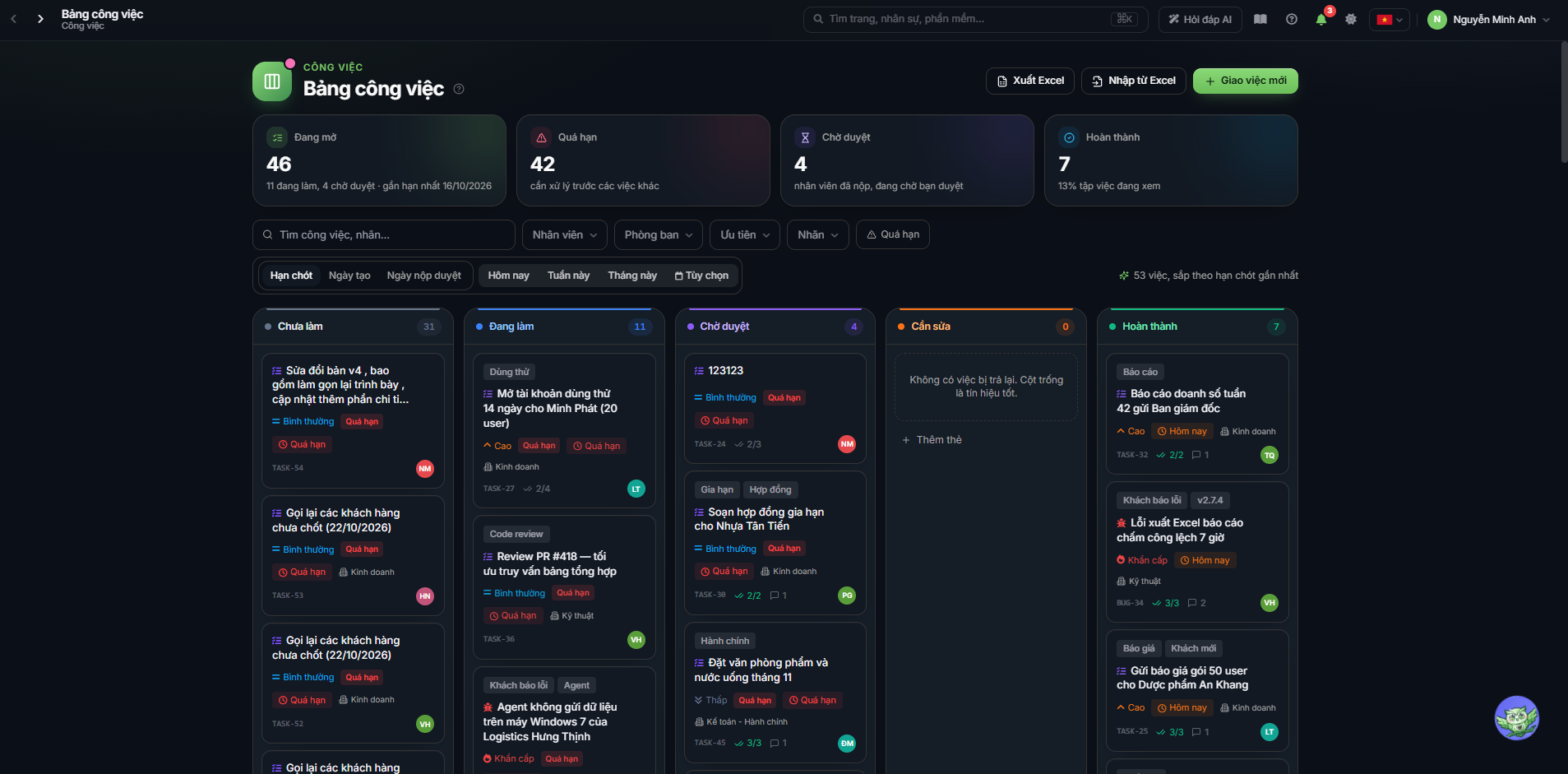
Tracking work items by status, priority and deadline on a single board.
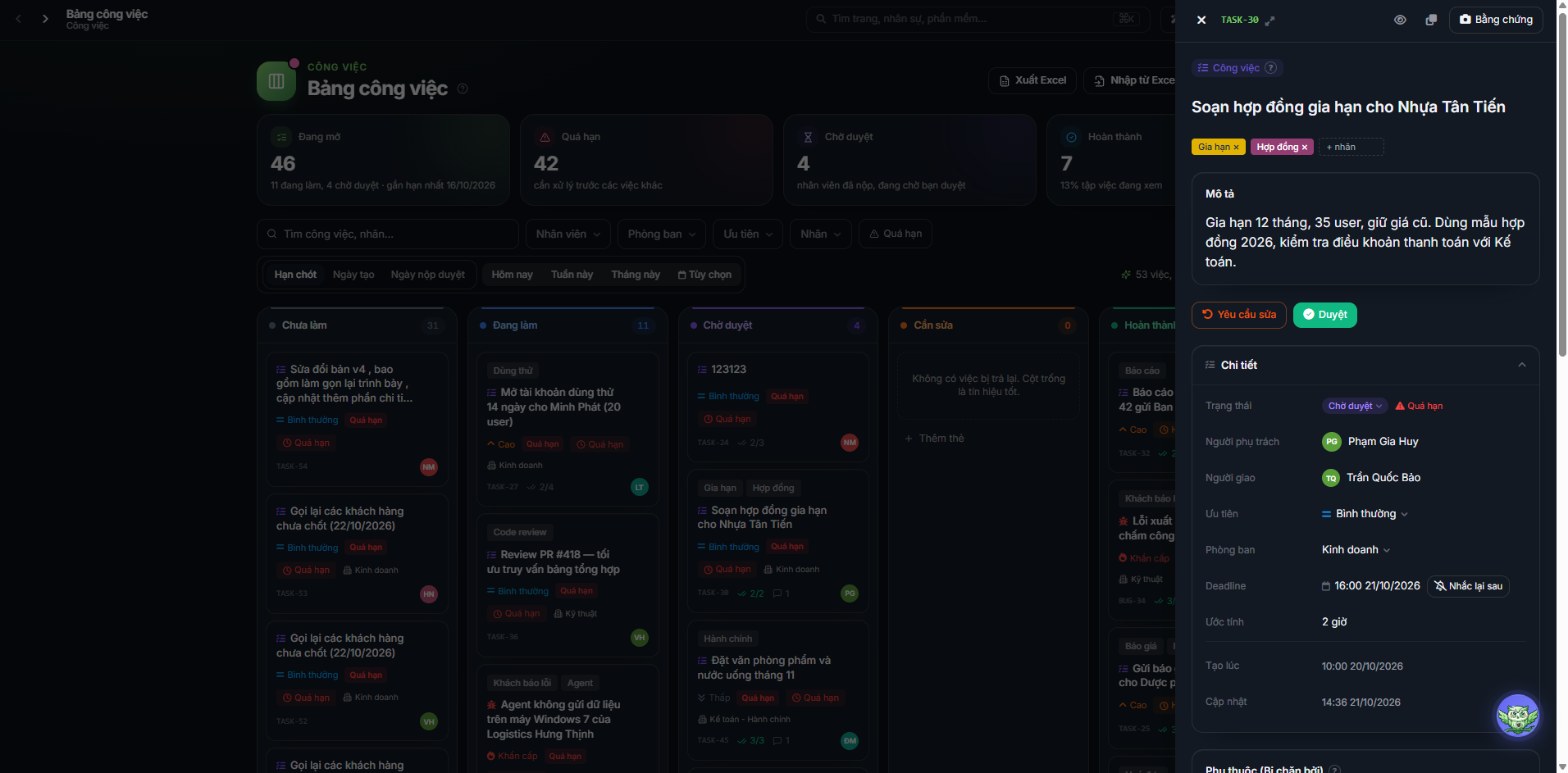
Work results are reviewed, approved or sent back for revision before completion is confirmed.
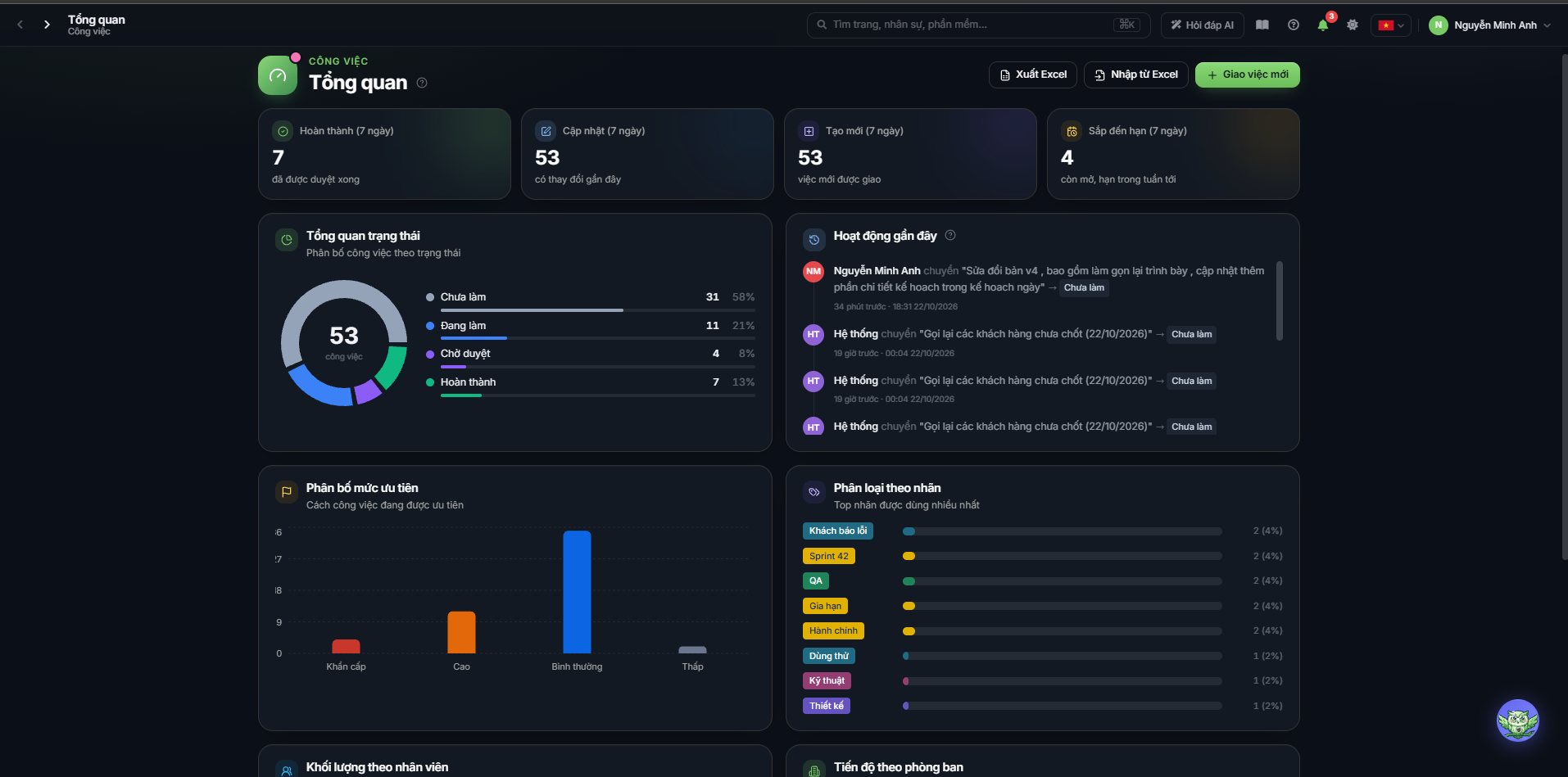
DearPulse summarizes work status and recent activity to identify what needs follow-up.
DearPulse is not FPT SPro or AMIS Công việc, and the results of these two organizations cannot be treated as DearPulse customer results. The reasonable connection lies in the management method: get the data first, find the right bottleneck, change the process, then measure again.
6. What data does DearPulse need to evaluate team performance?
From the data FPT IS has published, the verifiable metrics are the total number of work items resolved, the on-time completion rate and the completion time of a business process. From the MEDDOM case study, the source shows the ability to track the number of tasks created, completed and delayed against plan [1][3].
These metrics are meaningful only when accompanied by a clear measurement period and definitions. FPT IS’s 85% on-time rate is not an 85% increase; MEDDOM’s 4,000–5,000 tasks a month is the volume generated, not added productivity; and nearly 90 system users does not equal the number of staff optimized.
For DearPulse, priority should go to data that already exists and is confirmed in the product, such as owner, status, deadline and work outcome. Until it is verified that there are fields recording waiting/approval timestamps or automatic waiting-time calculation, these metrics must not be described as existing features.
Conclusion: Don’t add up employee busyness to calculate team performance
FPT IS shows the value of digitizing the processing flow, with quantified results for workload, on-time rate and payment time. MEDDOM shows the need for centralized management when an organization must coordinate thousands of tasks every month.
From this evidence, the lesson for CEOs and department heads is that team performance lies in the ability to move work from request to result, not just in how many hours each employee is busy. To optimize staffing, you need to see where work is delayed, at which person and which step, for how long and for what reason. DearPulse’s work, process and dashboard data can support that review within the scope of features already deployed.
See how DearPulse manages tasks, progress and work outcomes on your business’s real data in a product demo.
Sources and limitations
Scope of interpretation: The FPT IS and MEDDOM results were published in the implementing organizations’ own introductory materials/case studies; they are not independently verified studies. Do not infer a percentage productivity gain from on-time rates, task counts or the number of software users.