When working hours stretch out, the usual reaction is to hire more people or to ask the team to "push a bit harder". Both can be wrong if you do not yet know where the time is being consumed. Overtime is only an input signal; the cause may be a genuine rise in demand, a calendar chopped into fragments, a process stuck in approvals, dependency on a handful of individuals, or a culture that celebrates being present.
ActivTrak recorded a 46% rise in productive hours worked on Saturdays in its State of the Workplace 2026 dataset. That number does not prove every business is overloaded, but it shows that in the sample studied, work tends to spill out beyond the working week. The ILO likewise reports that more than a third of workers worldwide regularly work more than 48 hours a week. Together, these two data points change the management question from "who is working late?" to "what mechanism is pushing work outside working hours?".
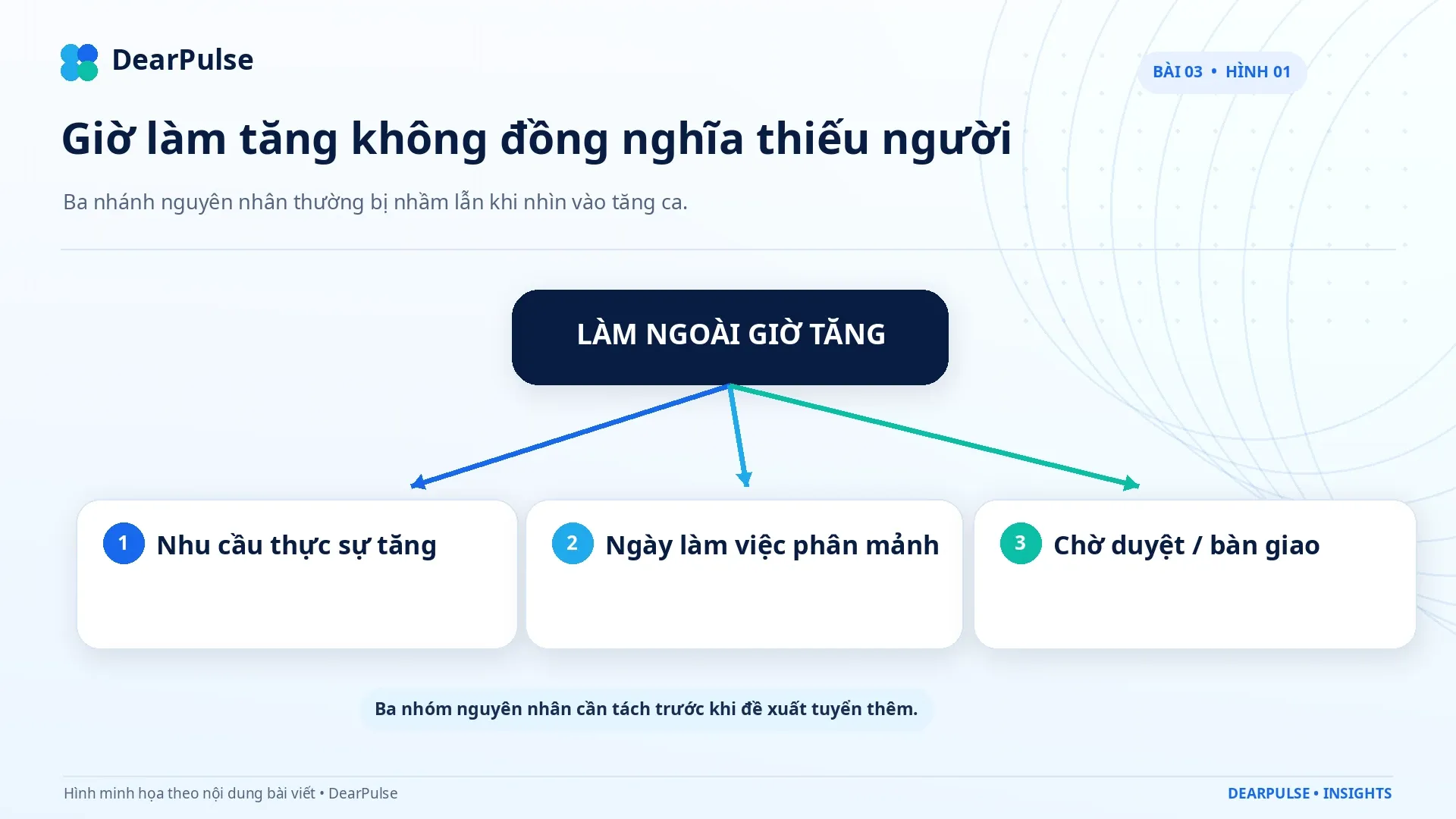
1. Five causes that must be separated
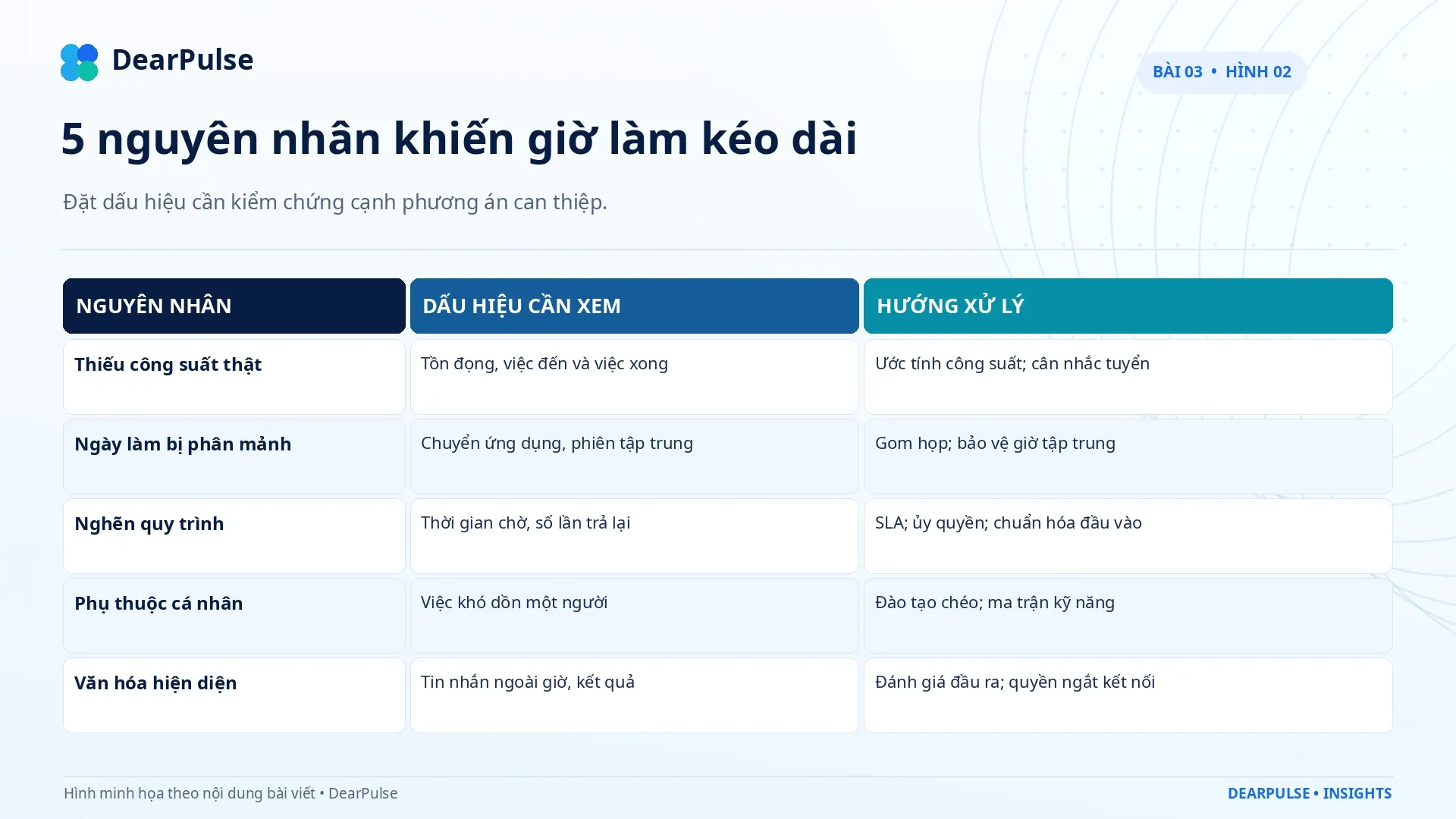
Cause 1 — Workload genuinely exceeds capacity
Mechanism: new requests arrive faster than the available hours can absorb them, while complexity and quality standards do not go down.
Signs to look for: a backlog that keeps growing; completion times rising for most team members; high-priority work still slipping; more hours worked, but completed output rising in proportion too.
Solution: estimate demand weekly, work out available capacity after subtracting meetings and operational work, then cap the amount of work in progress. If the shortfall repeats across several cycles and does not disappear after improvements, only then is hiring or using flexible resourcing well-founded.
Cause 2 — The workday is fragmented
Mechanism: meetings, messages and ad-hoc requests split time into lots of short stretches. Employees are present for the full day but never get a focus block long enough to finish complex work, so they make it up in the evening.
Signs to look for: frequent app switching; short focus sessions; meetings wedged between stretches of deep work; core output concentrated after office hours.
Solution: batch meetings into windows, establish uninterrupted focus hours, use asynchronous channels for status updates and define what genuinely counts as urgent. Then re-measure focus-session length and the share of work completed within working hours, not just total time online.
Cause 3 — Work is sitting and waiting inside the process
Mechanism: a file takes only 30 minutes to process but waits two days to be approved, to have data added or to receive feedback. The person doing the work has to keep coming back to it, which creates context switching and pushes work towards the deadline.
Signs to look for: waiting time greater than processing time; many items stalling at the same step; a high rate of items being sent back; overtime appearing right before approval milestones.
Solution: set an SLA for each step, define the thresholds people can decide for themselves, standardise input data and raise early alerts on files that have sat still too long. Fix the step with the largest queue before adding headcount across the whole process.
Cause 4 — Skill dependency, or the "hero" problem
Mechanism: only a handful of people have the authority, knowledge or experience to handle difficult work. They do their own share while also fixing errors, supporting colleagues and approving other people's work.
Signs to look for: one person involved in too many work streams; waiting times rising whenever that person is away; a high share of work bounced back to the same expert.
Solution: build a skills matrix, pair people up on real work, write checklists for recurring situations and train up backups. The goal is not to split everything evenly, but to reduce the risk of a single point of dependency.
Cause 5 — Culture and metrics reward presence
Mechanism: managers respond quickly to late-night messages, praise people who are "always online", or use total active hours as a proxy for contribution. Employees learn to stretch out their time instead of optimising results.
Signs to look for: after-hours messages unconnected to any incident; people who work longer not necessarily achieving better results; unclear output goals and quality standards.
Solution: shift evaluation towards results, quality, on-time delivery and a sustainable workload; establish send-later rules and a right to disconnect; managers must set the example.
2. How to identify the cause before hiring
Read four layers of data at the same time:
-
Demand: volume of incoming work, complexity and seasonality.
-
Capacity: available hours, skills and allocation levels.
-
Flow: processing time, waiting time, number of handovers and rework.
-
Results: output, quality, on-time delivery and customer feedback.
If demand is rising sustainably, capacity is being used sensibly and waiting time and rework are low, understaffing is a strong hypothesis. If total hours are high but focus sessions are short, the queue is concentrated at one step, or there is a lot of rework, fix the design of the work first.
3. A 30-day plan
Week 1: pick one team and establish a baseline for hours worked, work arriving, work completed, waiting time and rework.
Week 2: classify against the five causes; run short interviews to validate the data rather than inferring everything from software.
Week 3: trial one targeted change, such as two focus windows a day or a self-approval threshold.
Week 4: compare before and after on overtime hours, completion speed, quality and workload. Only open a hiring proposal if the shortfall remains after the trial.
4. Workplace wellbeing: use data to prevent, not to diagnose
The WHO classifies occupational burnout as an occupational phenomenon, not a medical condition. DearPulse data can therefore help surface patterns of prolonged or unbalanced work as a way to open a conversation, but it must not be used to diagnose health conditions or to label individuals.
The role of DearPulse
DearPulse can help you observe activity duration, focus rhythm, work allocation and waiting points, by role and within granted permissions. The value lies in pairing time data with work data in order to choose the right intervention — not in tracking every minute as an end in itself.
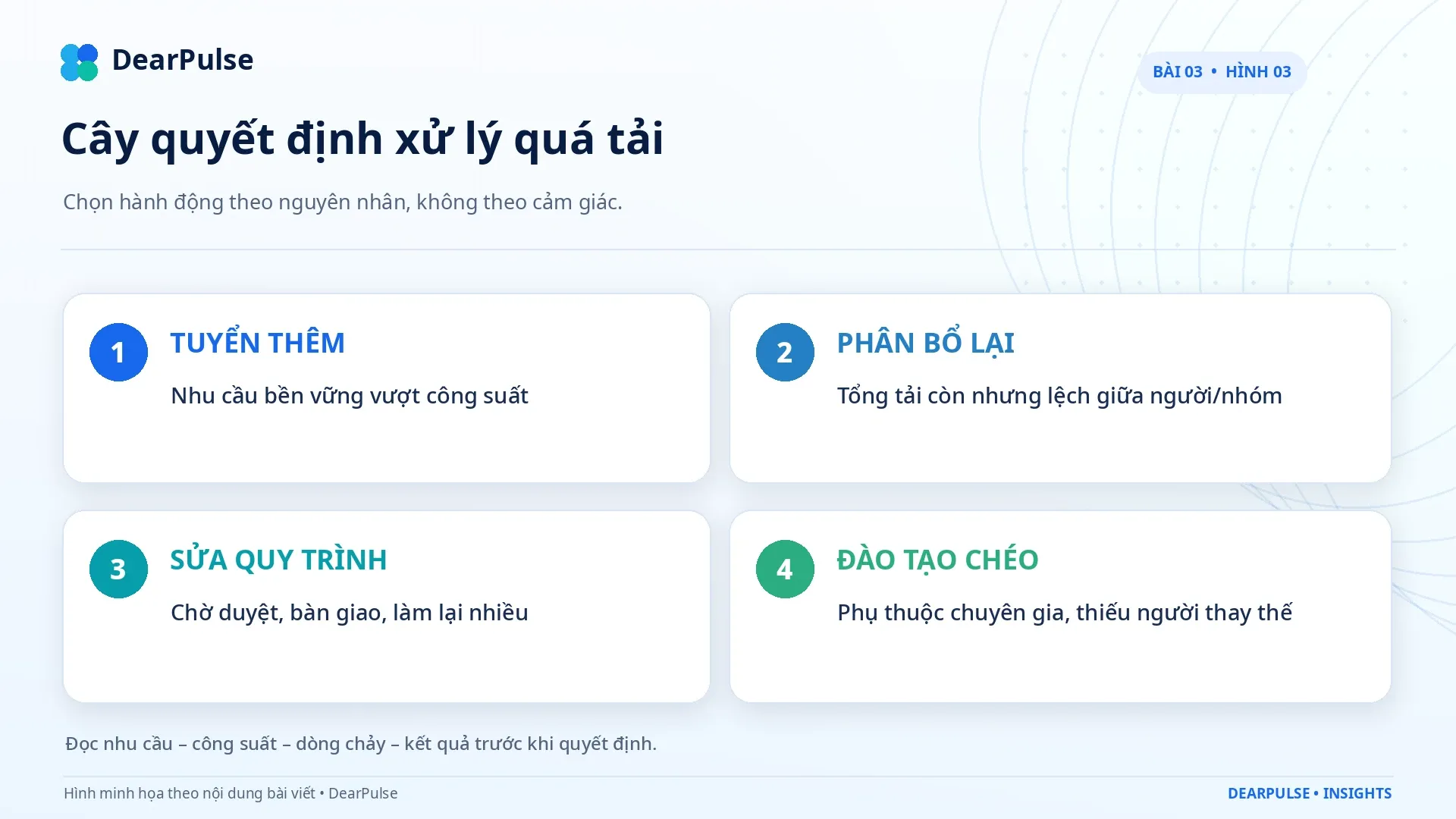
Conclusion
A single number about hours worked is not enough to make a staffing decision. The point of this article is to turn "overtime" from a judgement about people into a systems-diagnosis problem: identify the real cause, trial a small solution, and add resources only when the data proves capacity really is short.
References
ActivTrak, State of the Workplace 2026
International Labour Organization, Working Time and Work-Life Balance Around the World
World Health Organization, Burn-out an occupational phenomenon