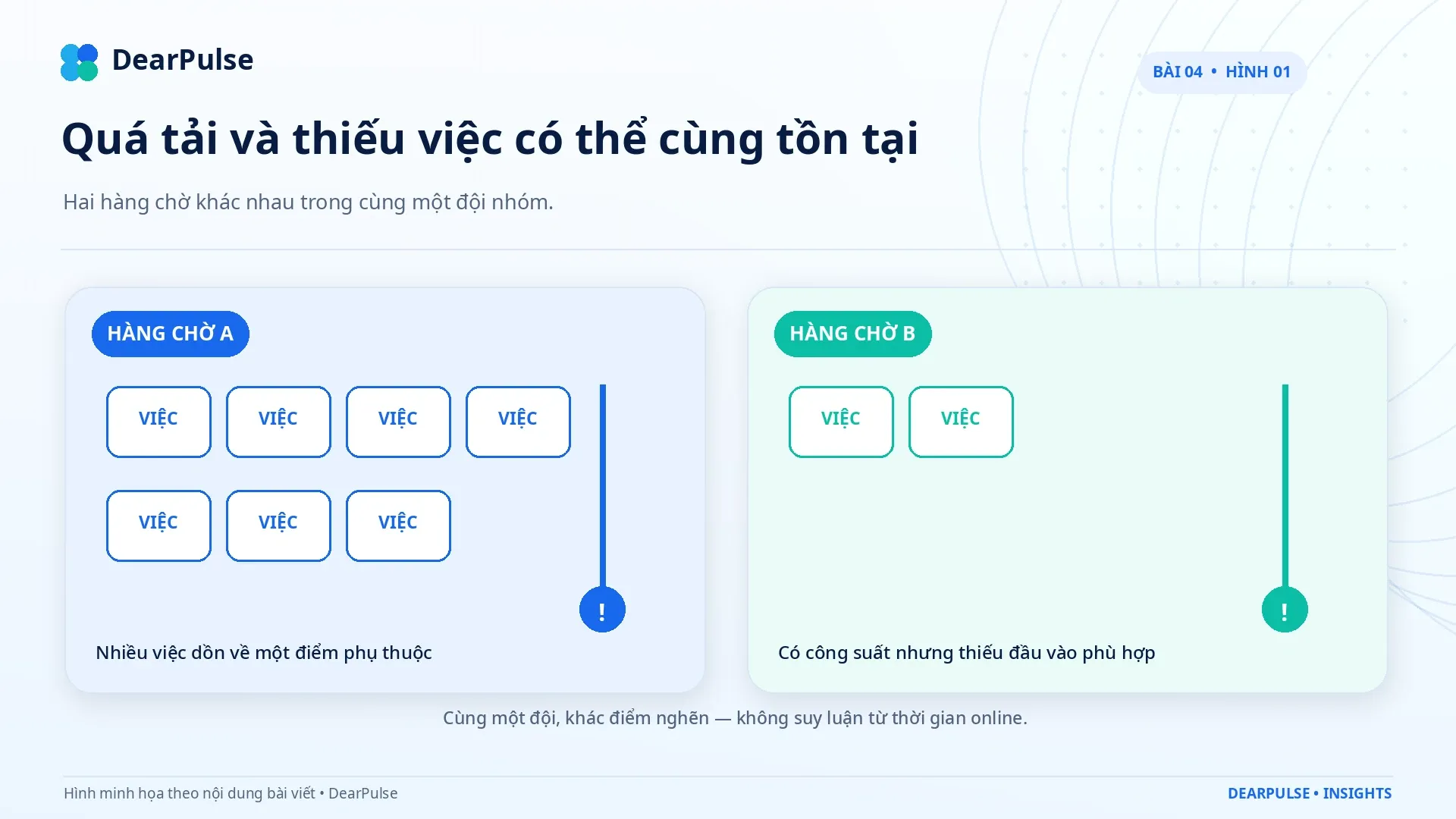
Overload and underutilization can coexist in the same department because work is not a set of “hour units” that can be divided evenly. Every task requires different skills, decision rights, information and timing. If leaders look only at total headcount or total hours, they see a paradox; if they look at the flow of work, the paradox usually turns into a handful of specific bottlenecks.
In its State of the Workplace 2026 report, ActivTrak found that the share of overloaded employees fell from 12% to 7% and the share of underutilized employees fell from 22% to 18%, yet the risk of disengagement rose from 19% to 23%. This is observational data from ActivTrak’s customer sample, not a benchmark for every business. Still, it illustrates an important point: simply cutting workload to the extreme does not automatically create engagement; the work must also fit people’s skills, sense of purpose and autonomy.
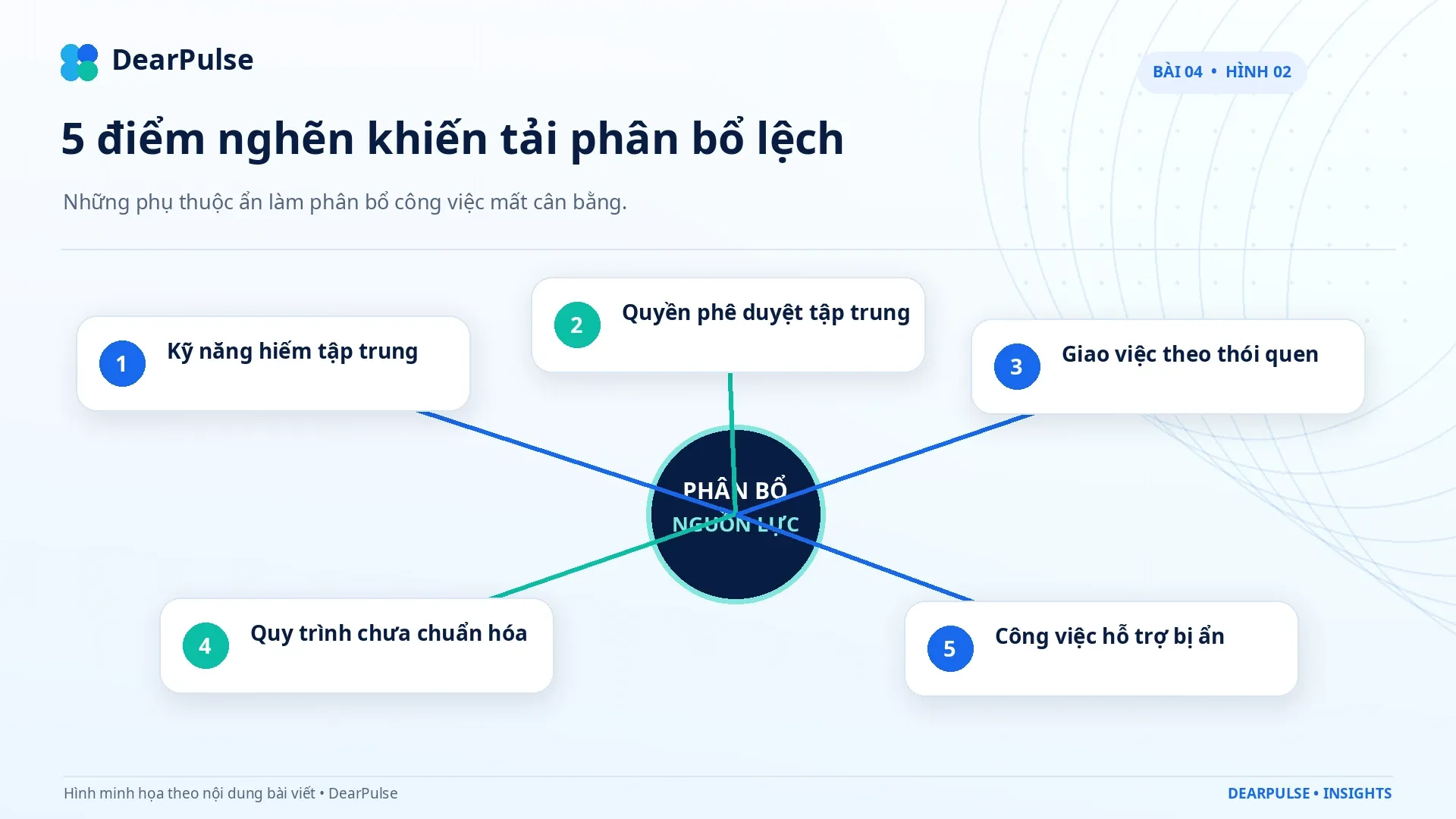
1. Five causes of uneven workload distribution
Cause 1 — Scarce skills concentrated in a few people
Mechanism: difficult work does not find the best person on its own. Over time, those people become the default destination, while everyone else only receives simple tasks.
Signs to look for: the same person handles most of the complex work; tasks are sent back after being assigned; when a key person is out, the queue grows.
Solution: build a skills matrix with levels such as can assist, can do independently and can coach; pair people on real cases; set a goal of increasing the number of people who can handle each type of work. Do not hand out difficult tasks across the board before a quality-control mechanism is in place.
Cause 2 — Concentrated approval authority
Mechanism: many people can prepare the work, but only one manager is allowed to decide. The approver is overloaded while the doers wait for work or keep chasing status.
Signs to look for: a long approval queue; many files sent back only because of minor missing information; manager calendars filled with repetitive decisions.
Solution: tier decisions by value and risk, standardize input checklists and delegate cases below a threshold. Track waiting time and exception rates to adjust the threshold.
Cause 3 — Assigning work by habit and trust
Mechanism: to keep to schedule, managers keep giving work to people who have already proven themselves. This is optimal in the short term but creates overload and fails to build backup capability.
Signs to look for: newcomers rarely receive valuable work; the same type of task always lands with the same person; workload doesn’t change even though team capability has grown.
Solution: set assignment rules based on workload, skills and development opportunities; reserve part of the work for supervised training; evaluate managers on their ability to build a team, not just on immediate results.
Cause 4 — Work that has not been standardized
Mechanism: the process lives in individual memory. Experienced people work fast, while others lack the information to get started or must keep asking questions.
Signs to look for: large differences in handling time; recurring errors; many identical questions; hard-to-hand-over tasks.
Solution: start with the 20% of situations that generate 80% of the volume, and write short SOPs, templates and completion criteria; update documentation from real mistakes rather than writing one oversized handbook.
Cause 5 — Hidden workload
Mechanism: internal support, bug fixes, meetings and ad hoc work are not captured in the task assignment system. Official reports show someone with “little work,” yet their time has already been consumed.
Signs to look for: a gap between the task list and actual time spent; many requests coming through chat; work that gets done but has no clear owner.
Solution: create an operations/support work category, record it in enough detail to see trends, and set limits on unplanned requests. The goal is to see the real workload, not to add reporting overhead.
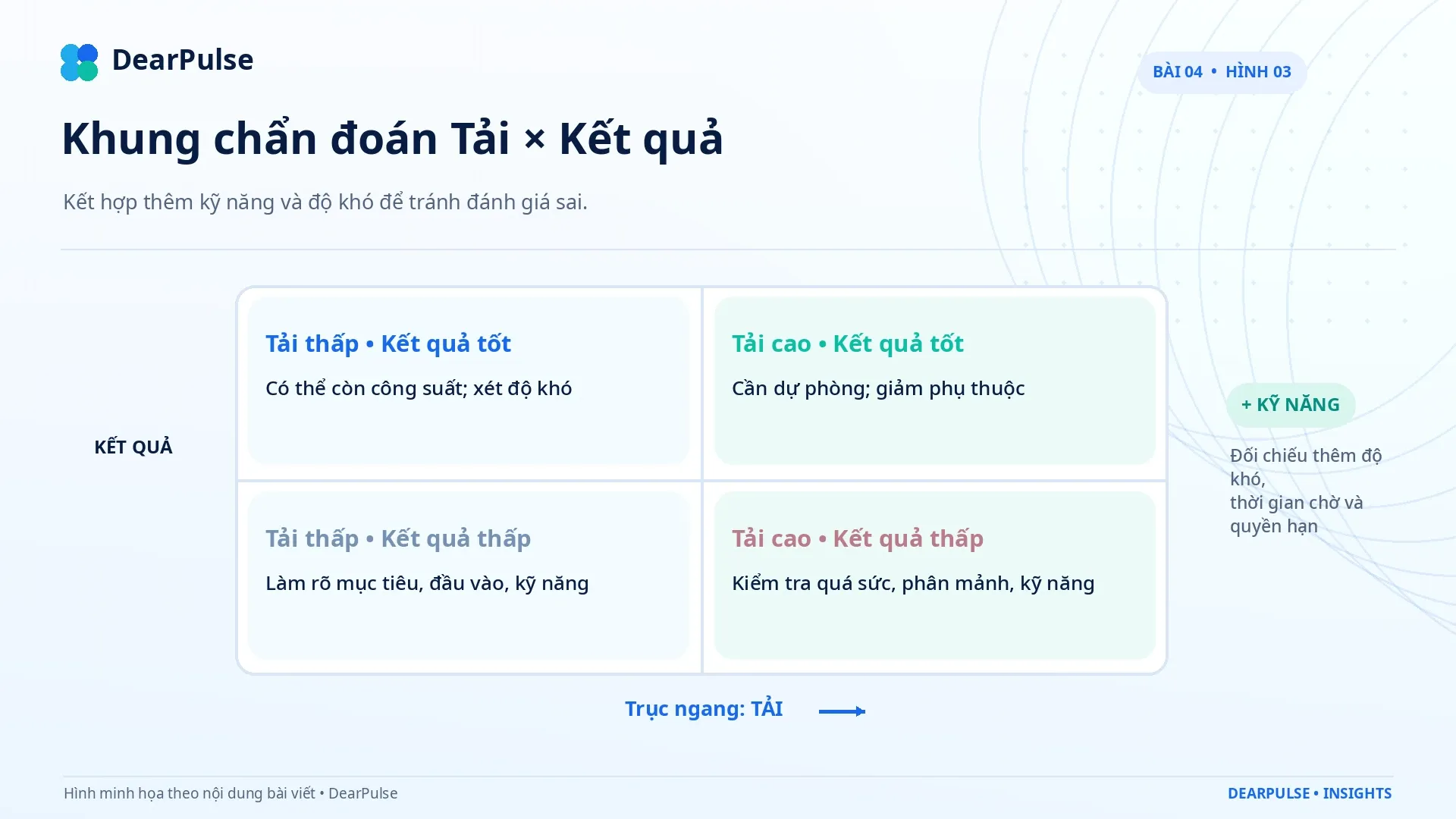
2. The Workload × Skills × Outcomes diagnostic framework
Don’t draw conclusions from a single axis:
-
High workload + good results: possibly a key person; you need backup and less dependence on them.
-
High workload + low results: possibly overstretched, fragmented or lacking skills.
-
Low workload + good results: possibly spare capacity, or difficult tasks that are small in number.
-
Low workload + low results: you need to clarify goals, capability, inputs and engagement.
After placing each role in the framework, also check waiting time and complexity. Two people may each have 10 tasks yet carry completely different loads if one handles exceptions and the other does standardized work.
3. Solutions by level
Individual level: clarify priorities, provide training and limit the number of open tasks.
Team level: a skills matrix, controlled rotation and assignment rules.
Process level: delegation, SLAs, SOPs and removing steps that add no value.
Management level: a workload-versus-outcomes dashboard that shows trends, without ranking individuals by a single composite number.
4. A 30-day plan
Week 1: tally work by type, complexity, assignee and waiting time.
Week 2: build the skills matrix and identify the three biggest dependencies.
Week 3: test one change: delegation below a threshold, pairing, or workload-based routing.
Week 4: re-measure waiting time, number of tasks sent back, on-time rate and employees’ perceived workload. Scale up when quality does not drop.
The role of DearPulse
DearPulse can help cross-check work allocation, activity rhythm and outcomes by team/role, and so suggest where a conversation is needed. The data must be used alongside the context of skills and difficulty; never use activity time alone to label someone “idle” or “overloaded.”
Conclusion
Balancing workload does not mean splitting the number of tasks evenly. The goal is to route the right kind of work to the people with the right capabilities, while expanding backup capacity and shortening waiting time. Only then can a business reduce overload without leaving a group of employees outside the flow of value.