Requests to hire more people usually begin with a real experience: the backlog grows, employees are overloaded, customers have to wait. But the symptom of “not enough people” may come from a genuine shortage of capacity, or it may come from time being locked up in approval waits, duplicate data entry, rework or uneven allocation. If you hire before diagnosing, a business may simply add more people to the very process that is wasting their time.
The ILO emphasizes that high productivity comes not only from individual effort but from an ecosystem of efficiently operating businesses. That shifts the question from “Do we need more people?” to “Which unit of value lacks capacity, and why?”
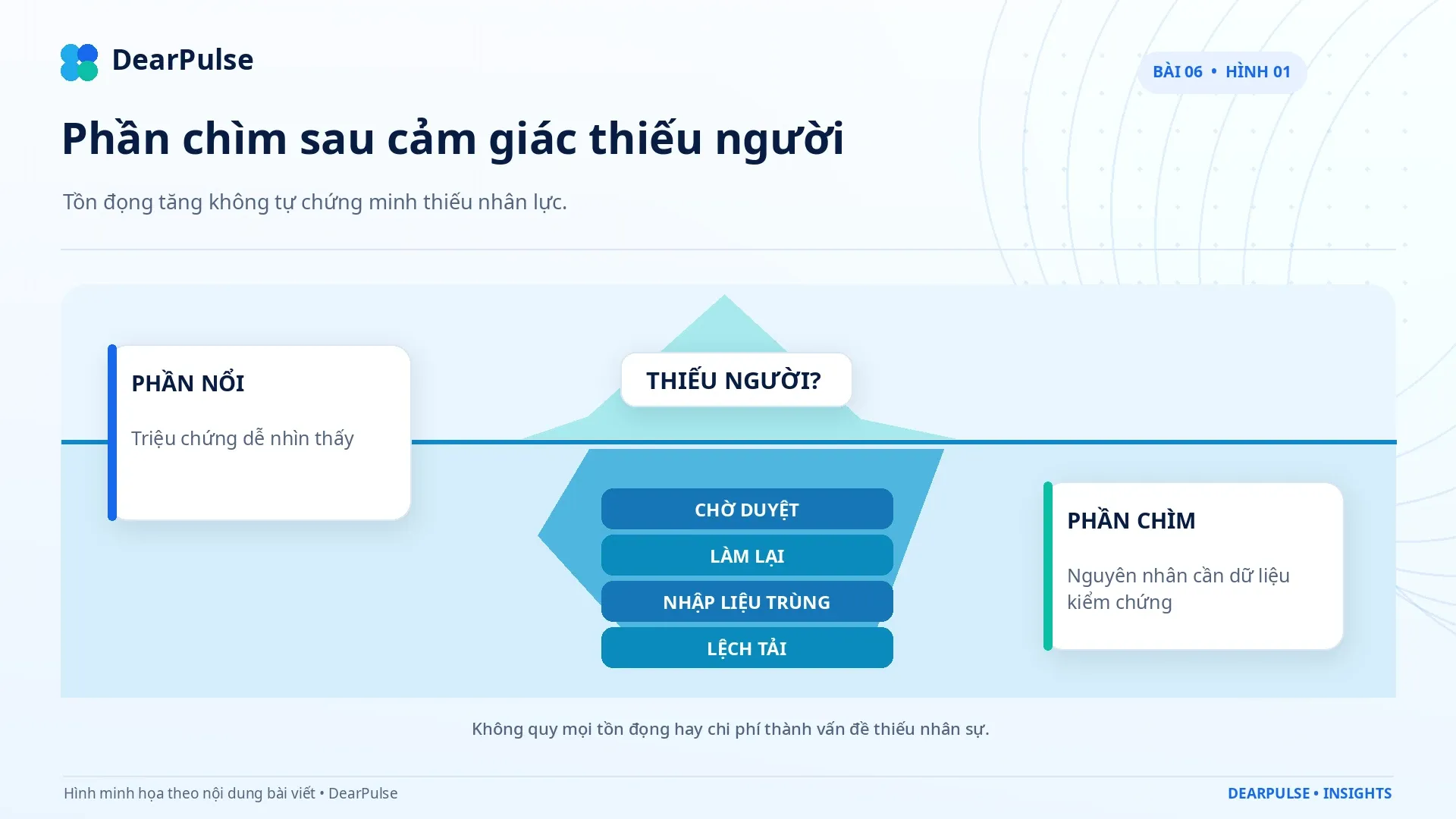
1. Five causes of the feeling of being understaffed
Cause 1 — Approvals and handoffs take too long
Mechanism: completion time is long, but most of it is spent waiting for a decision, for data or for another department.
Signs: waiting time exceeds handling time; many tasks stall at the same step; doers keep asking for status.
Solution: set SLAs, standardize inputs, delegate below a threshold and reduce the number of handoffs. Hiring more processors won’t help if the bottleneck is a single approval level.
Cause 2 — Duplicate data entry, searching and reporting
Mechanism: data sits in several software systems, and employees copy it manually or redo the same report for different recipients.
Signs: administrative time grows; the same information appears on several forms; copy errors and version mismatches.
Solution: define the standard source of data, drop reports that nobody uses, and integrate or automate repetitive steps. Only automate after you have eliminated unnecessary steps.
Cause 3 — Rework caused by low-quality inputs
Mechanism: work that is “done” comes back because of missing information, wrong standards or differing interpretations of the requirements. Surface output goes up, but net capacity goes down.
Signs: high reopen/return rates; many rounds of revision; errors concentrated at one input source.
Solution: define criteria for readiness and completion, use short checklists, and feed errors back to their true source. Measure the first-time-right rate instead of only counting completions.
Cause 4 — Uneven resource allocation
Mechanism: some people are overloaded because of their skills, assignment habits or access rights, while capacity elsewhere cannot be brought in.
Signs: backlog concentrated by person/type of work; large workload gaps; work being pushed back to specialists.
Solution: skills matrix, cross-training, routing by workload and difficulty, and granting the necessary access. Hiring is justified only if the skills gap cannot be developed within the business timeframe.
Cause 5 — Seasonal demand mistaken for a long-term shortage
Mechanism: short peaks make monthly average data look as if capacity is always short.
Signs: backlog recurs by season/event; workload drops sharply after the peak; demand is hard to forecast but not continuous.
Solution: use flexible shifts, freelancers, temporary reassignment or schedule smoothing. Hire permanently when baseline demand rises sustainably, not just because of a short spike.

2. A four-way decision tree
Hire more when: demand is growing sustainably; rework and waiting rates are already low; the current team has reached a safe workload threshold; and the capacity gap can be quantified.
Reallocate when: total capacity remains but the load is skewed by person/team; skills are transferable.
Fix the process when: waiting time, handoffs, rework or repetitive operations account for a large share of the time.
Use flexible resources when: demand is seasonal or projects have a clear end point.
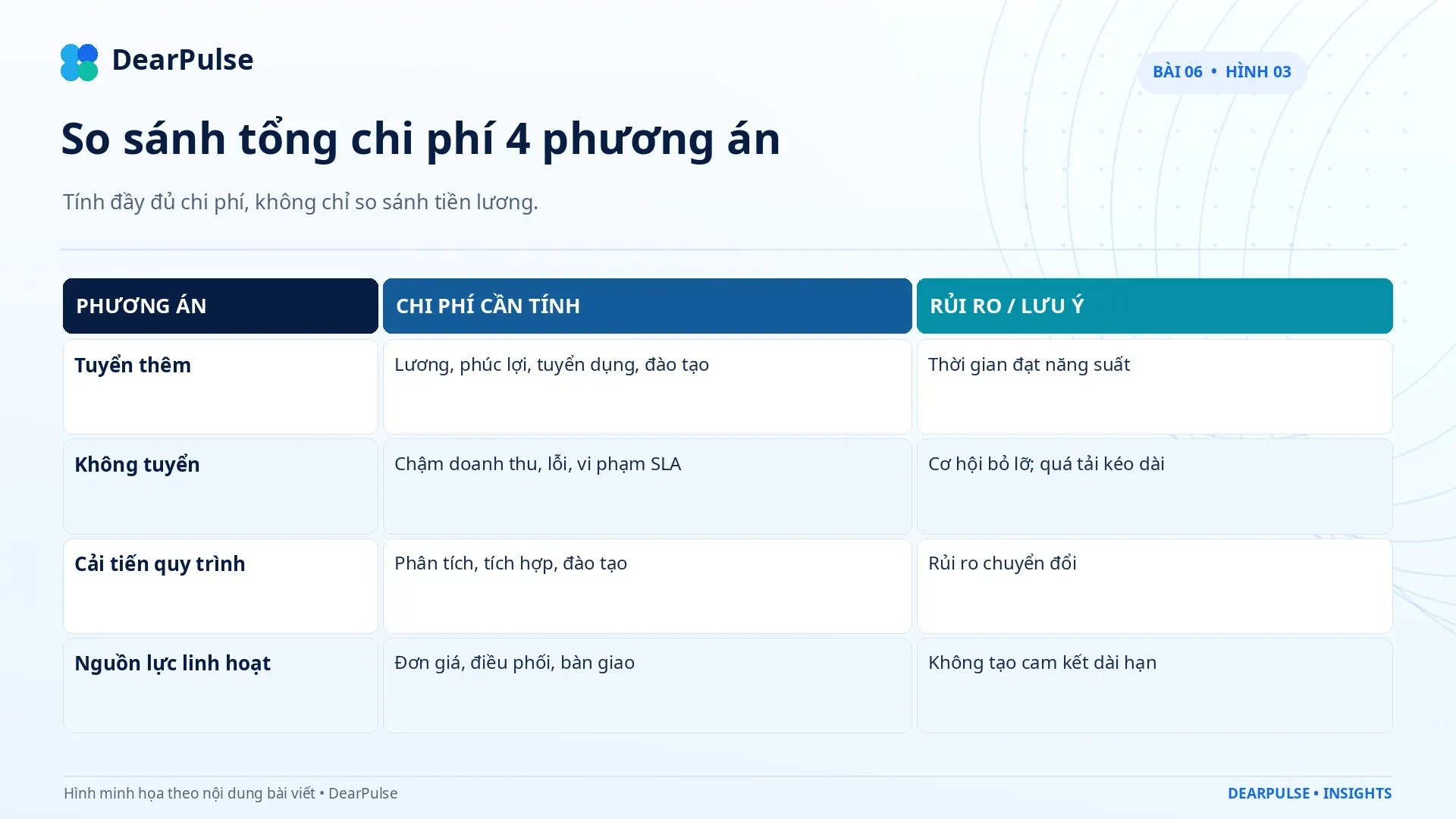
3. Count the full cost
Don’t just compare a new hire’s salary with the cost of software. Account for:
-
Hiring: salary, benefits, recruitment, management time and time to reach full productivity.
-
Not hiring: delayed revenue, SLA breaches, errors, attrition and missed opportunities.
-
Improvement: analysis time, integration, training and transition risk.
-
Flexible resources: a higher unit price but no long-term commitment.
An option that looks cheap on the price list can end up costing more if it increases errors or slows service.
4. A 30-day process audit
Week 1: pick a workflow with a high backlog; measure incoming work, completed work, handling time, waiting time and rework.
Week 2: map the steps and identify the bottleneck; interview the people doing the work to explain the data.
Week 3: try removing, merging, delegating or automating one step.
Week 4: re-measure speed, quality, workload and backlog. Build a hiring business case only for the remaining gap.
5. Decision-making principles
Don’t use high activity levels to prove understaffing. High activity can reflect fragmentation or waste. Strong evidence must connect demand, capacity, flow and outcomes. A decision also needs a review date so that a temporary fix does not become a permanent structure.
The role of DearPulse
DearPulse can bring together signals about workload, work allocation, focus time and process status to pinpoint where to look. The system supports diagnosis; a hiring decision still requires financial data, business demand and conversations with the team.
Conclusion
Hiring more is the right call when a business still lacks capacity after the main sources of waste have been ruled out. Fixing the process is the right call when time is being lost inside the system. A diagnostic framework helps a business avoid both mistakes: making the team struggle for too long, and hiring people just to feed an inefficient process.
References
International Labour Organization, When businesses operate efficiently